Languages & Culture
Mongolian
Mongolian names a set of closely connected spoken and written varieties whose principal centres are Mongolia and Inner Mongolia in China. It belongs to the Mongolic language family. A useful introduction must distinguish the broad name from Khalkha, the main reference variety in Mongolia, and from the whole Mongolic family. Shared ancestry does not make every related community's speech interchangeable.
A language across a border
Khalkha is central to the national language of Mongolia, while related Mongolian varieties have their own communities in Inner Mongolia. Indiana University's overview also places Buryat and Kalmyk within a wider field of related speech. They should not simply be absorbed into a beginner course labelled Mongolian: their histories and linguistic descriptions require attention in their own right. Here, the focus is Mongolia and Inner Mongolia, with regional differences acknowledged rather than a single accent or ethnic population taken as the measure of the language.
The grammatical structure offers another way into the subject. The publisher's summary of Juha A. Janhunen's scholarly grammar describes extensive suffixation: endings attach to stems to build grammatical forms. It also identifies vowel harmony and a tendency for verbs to come at the end of sentences. These are useful organising principles for learning, rather than an invitation to translate English word by word. Janhunen's stated scope includes standard spoken varieties used in education, broadcasting and ordinary conversation, showing why a grammar can address shared patterns while still considering variation.
Writing has more than one history
The traditional vertical script developed from Uyghur writing and was adopted in the early Mongolian state. Later centuries brought other writing experiments and adaptations. During the twentieth century, Cyrillic became the main writing system in Mongolia, while traditional-script writing continued in Inner Mongolia. These histories explain why Mongolian can appear in strikingly different graphic forms. A writing system is not, by itself, a separate spoken language; nor does a shared script establish identical pronunciation across regions.
Digitisation has made the relationship between writing and institutions especially visible. In a 2025 study, Tergel Teneg examined the traditional script's difficult passage into Unicode and digital platforms. His analysis describes competing ways of encoding or displaying letters, inconsistent rendering and problems exchanging usable text. It also considers the roles of governments, researchers and collaboration across the Mongolia–China border. This is a dated research account, not a claim that every current application behaves identically. Its broader lesson is practical: making text visible on one screen does not necessarily make it searchable or reliably reusable elsewhere.
The hand, the page and the gallery
Calligraphy gives the traditional script a further cultural setting. UNESCO's description of a 2011 documentary explains how connected vertical strokes form words and how practitioners learn through sustained mentoring. This is skilled work with movement and proportion, not simply decorative lettering added to an otherwise finished text. The documentary record also reminds readers to distinguish a historical account of practitioners from evidence about their numbers today.
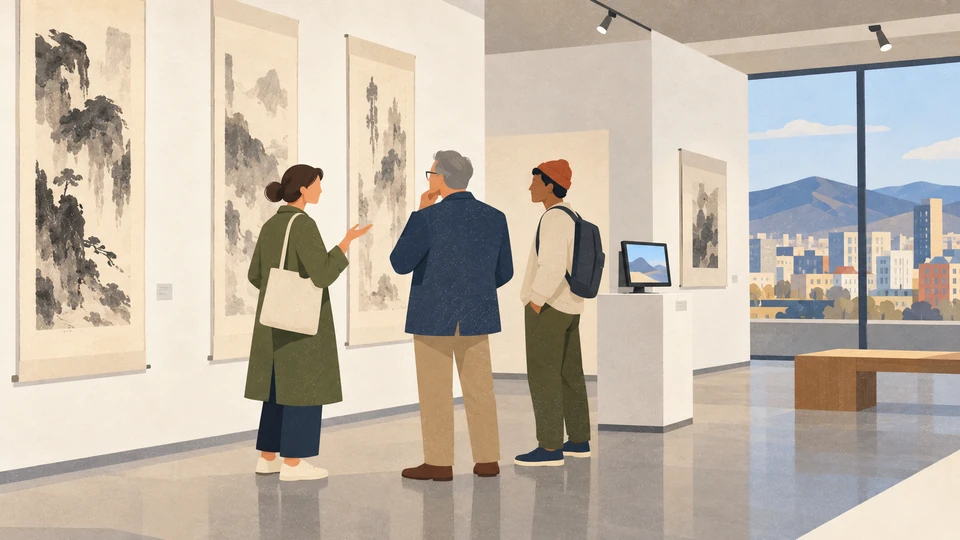
Contemporary artists continue to explore the script's possibilities. LKHAM Gallery in Ulaanbaatar dates its exhibition The Gesture of the Language – Calligraphy & digital imaginaries to September–October 2026. The organiser describes bringing Mongolian calligraphy into conversation with contemporary art and digital technology. This particular exhibition provides evidence of artistic experimentation, rather than a claim that one style represents all Mongolian speakers. The script can be a subject of new work as well as a connection with earlier writing.
Listening beyond a national narrative
Documentation also preserves how individuals recount their lives. The Oral History of Twentieth Century Mongolia began in July 2007 as a collaboration between the University of Cambridge and the National University of Mongolia. Its project overview describes collected accounts from people with very different backgrounds, examining memories of socialism, urbanisation and subsequent change. Researchers recorded information about interviewers and interview settings alongside the narrators themselves. Those details matter because a remembered life is told to someone, at a particular moment. Such records broaden an introduction to Mongolian beyond alphabets and grammatical rules: they make room for individual experiences, perspectives and ways of telling.
Sources
- Juha A. Janhunen; John Benjamins Publishing Company, London Oriental and African Language Library 19. Mongolian. https://benjamins.com/catalog/loall.19
- Indiana University Bloomington, Center for Languages of the Central Asian Region. Mongolian. https://celcar.indiana.edu/materials/language-portal/mongolian.html
- Tergel Teneg; University of Cambridge; Inner Asia 27 (2025), 277–313. The Digitisation Odyssey of the Mongolian Script in Unicode. https://api.repository.cam.ac.uk/server/api/core/bitstreams/dfc8cdaa-2e8c-439f-8dc1-e714a21f9c7c/content
- UNESCO Multimedia Archives; documentary director Jalair D. Batbayar; Calligraphy Center, Mongolia and Great Hunnu Pictures. Mongolian Calligraphy. https://www.unesco.org/archives/multimedia/document-3513
- LKHAM Gallery; curatorial approach by Frédéric Lemaigre and Fabien Zocco. The Gesture of the Language – Calligraphy & digital imaginaries. https://lkhamgallery.com/exhibition/the-gesture-of-the-language-calligraphy-digital-imaginaries/
- Mongolia and Inner Asia Studies Unit, University of Cambridge, in collaboration with the National University of Mongolia. Home. https://www.amantuuh.socanth.cam.ac.uk/pages/home.php
- The Oral History of Twentieth Century Mongolia; Mongolia and Inner Asia Studies Unit, University of Cambridge. The project -- Aims and history. https://www.amantuuh.socanth.cam.ac.uk/pages/project_overview.php