Languages & Culture
Nahuatl
Nahuatl connects living regional communities, historical manuscripts and contemporary research. It belongs to the Uto-Aztecan family, called yuto-nahua in Mexico’s national language catalogue. The broad name needs care: it does not identify one interchangeable form of speech across every community. A useful introduction therefore begins with the relationship between a shared grouping and the particular places, speakers and texts that give it substance.
Begin with a community
The Instituto Nacional de Lenguas Indígenas (INALI) organised its 2008 catalogue around families, groupings and variants. A grouping gathers varieties historically associated with a people; a variant also recognises structural differences and a distinctive sociolinguistic identity. The catalogue’s framework treats variants as languages, rather than making linguistic difference merely a matter of accent. That is a stated classificatory approach, not a universal answer to every question about language boundaries. Its Nahuatl table accordingly records regional designations, local self-designations and geographic references. A local name should not automatically become the name for everyone covered by the catalogue heading.
In a May 2025 overview, INALI identifies Nahuatl communities across states including Puebla, Veracruz, Hidalgo and Guerrero, while also recognising newer settlements in northern Mexico. It describes different degrees of language vitality among varieties. These differences matter: a broad speaker total would reveal little about whether children use a particular local variety or what support a community wants. Community circumstances deserve more attention than an undifferentiated national label.
Older texts, living readers
Classical Nahuatl usually enters a reader’s experience through historical written materials. Michel Launey’s introduction, for example, describes a corpus including narratives, speeches, chronicles and compilations of knowledge gathered or composed after the Spanish conquest. Studying that material is a valuable undertaking with its own textual demands; it should not be presented as a complete preparation for conversation in every contemporary community.
The sixteenth-century Florentine Codex makes the intellectual work behind such texts especially visible. Nahua elders, grammarians, scribes and artists collaborated with the Franciscan Bernardino de Sahagún on an illustrated manuscript about Mexica life and knowledge, written in Nahuatl and Spanish. Nahua participation also matters in its modern interpretation. Getty’s October 2023 digital-edition announcement credits Eduardo de la Cruz Cruz and Sabina Cruz de la Cruz with translating search tags into Eastern Huasteca Nahuatl. A historical manuscript can therefore become a meeting point for different periods of the language, with contemporary Nahua scholars helping determine how readers encounter it.
Speakers as teachers and researchers
The Zacatecas Institute for Teaching and Research in Ethnology, IDIEZ, sets out an approach that gives Nahuatl-speaking students active research and teaching responsibilities. Its 2018 institutional account describes scholarships, training and space for daily discussion in Nahuatl. It also explains why the institute studies older and modern language together: its work emphasises continuity between them. That is the institute’s educational approach, rather than a claim that historical and present-day forms are identical.
A University of Utah report documents this collaboration in practice during its summer 2025 programme with IDIEZ. Students learned from Nahua instructors through classroom teaching, small-group work and cultural activities. Embroidery was one of those activities, and the report records completed student projects and a participant’s reflection on the practice’s artistic and social significance. This is a specific example of language education involving material culture; it does not establish embroidery as a compulsory or universal marker of Nahua identity.
Knowledge in conversation
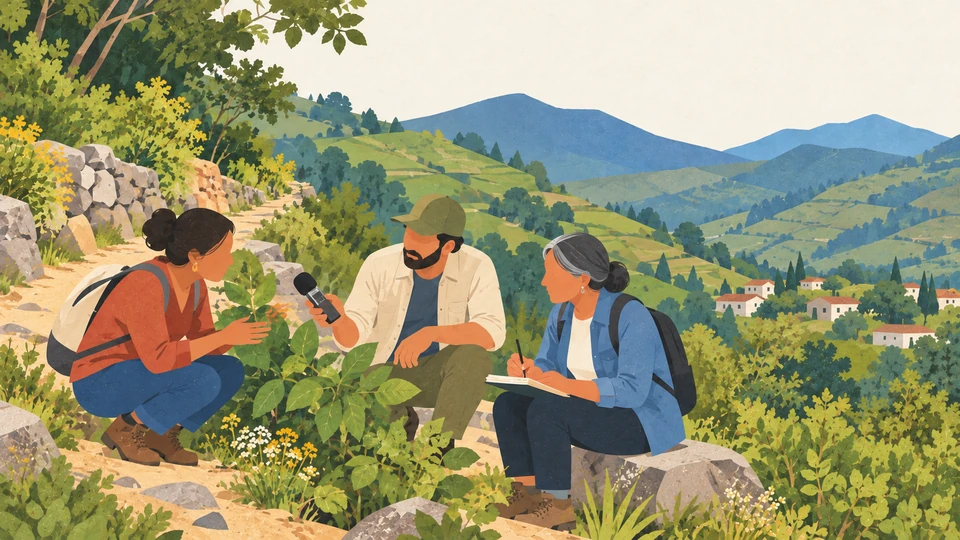
Documentation also happens outside classrooms. A corpus released by the Linguistic Data Consortium in 2021 describes field recordings made between 2008 and 2019 in Cuetzalan del Progreso and Tepetzintla, Puebla. Speakers discussed plant names, classifications and uses during collection work. The catalogue distinguishes the local varieties represented and describes a dictionary, botanical information and partially translated transcripts. Those materials show why recordings and contextual information complement a word list: a name occurs within explanations, distinctions and knowledge shared by speakers.
For a learner, these examples suggest a practical starting point: identify the community or historical material a resource serves, then seek teaching appropriate to that purpose. For a reader interested in culture, they offer a broader perspective on scholarship. Nahuatl-speaking people are producing explanations, teaching students and interpreting records, as well as supplying the speech that researchers document.
Sources
- Instituto Nacional de Lenguas Indígenas (INALI). Catálogo de las Lenguas Indígenas Nacionales: Variantes lingüísticas de México con sus autodenominaciones y referencias geoestadísticas. (2008-01-14). https://www.inali.gob.mx/pdf/CLIN_completo.pdf
- Instituto Nacional de Lenguas Indígenas (INALI). Agrupación lingüística: náhuatl. https://www.inali.gob.mx/sitios/clin-inali/html/l_nahuatl.html
- Instituto Nacional de Lenguas Indígenas (INALI). Lengua Nawatlahtolli (náhuatl) (2025-05-28). https://www.inali.gob.mx/detalle/lengua-nawatlahtolli-nahuatl
- Getty / Getty Research Institute; no individual article byline displayed. A Rare 500-Year-Old Manuscript Gets a Second Life Online (2023-10-26). https://www.getty.edu/news/a-rare-500-year-old-manuscript-gets-a-second-life-online/
- IDIEZ institutional self-description hosted by COLING, University of Warsaw. Zacatecas Institute for Teaching and Research in Ethnology (IDIEZ) (2018-01-01). https://coling.al.uw.edu.pl/partner/1670/
- Sumiko Martinez, Associate Director of Editorial & Media Strategy, College of Humanities, University of Utah. Center for Latin American Studies hosts annual Nahuatl Language & Culture Program (2025-09-04). https://attheu.utah.edu/events/center-for-latin-american-studies-hosts-annual-nahuatl-language-culture-program/
- Jonathan D. Amith; Amelia Domínguez Alcántara; Hermelindo Salazar Osollo; Ceferino Salgado Castañeda; Eleuterio Gorostiza Salgado. Linguistic Data Consortium, University of Pennsylvania.. Ethnobotanical Research and Language Documentation of Nahuatl (2021-07-15). https://catalog.ldc.upenn.edu/LDC2021S06
- Michel Launey; edited and translated by Christopher Mackay; Cambridge University Press. Preface — An Introduction to Classical Nahuatl. https://www.cambridge.org/core/books/abs/an-introduction-to-classical-nahuatl/preface/EA50071B301BBA5207903ADC00583B17