Languages & Culture
Navajo
Navajo, or Diné Bizaad, belongs to the Athabaskan language family. It is a living language whose speakers, teachers and researchers work in different settings across the American Southwest. The Navajo Nation extends across Arizona, New Mexico and Utah. That geography provides an important starting point, while university teaching and online learning also connect people beyond the Nation’s boundaries.
Learning through relationships
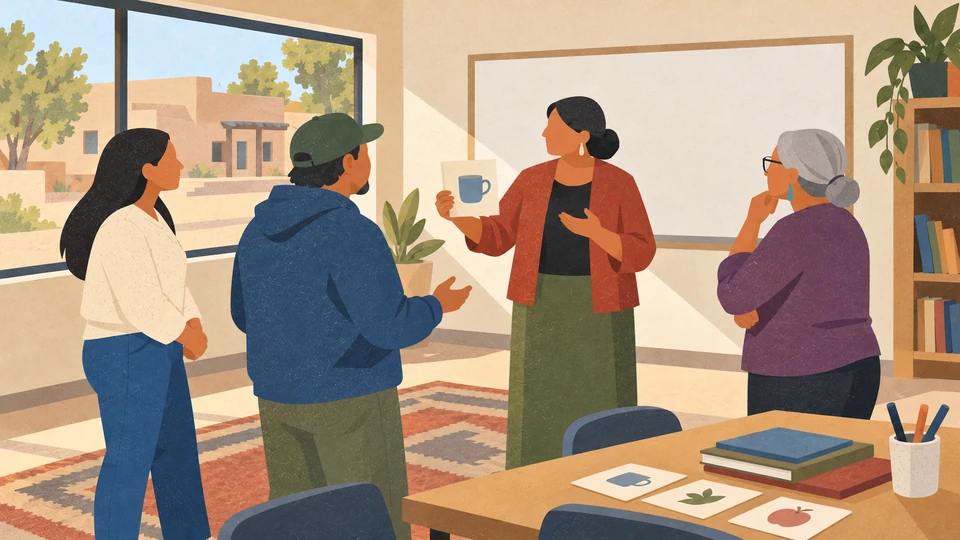
A Diné College account of a beginning Navajo class in Tsaile, Arizona, describes students learning through pictures, gestures, listening and conversation. Instructor Leigh A. Toadlena used clan-based introductions to help students identify their relationships with one another. Everyday exchanges, including roll call and simulated meetings, gave learners occasions to speak. This is a specific account of classroom practice, rather than a formula for every Navajo introduction. It shows why learning a language can involve understanding relationships as well as remembering words.
The distinction matters for learners who approach Navajo with different experiences. The University of New Mexico’s programme history records the introduction of online immersion courses in 2021, alongside its classroom teaching. It reports that these courses attracted students outside Albuquerque. Distance learning offers one route into organised study; it does not replace the family and community relationships through which people also learn.
Schooling, literacy and sustained scholarship
The history of Navajo education includes coercion. The Smithsonian’s National Museum of the American Indian preserves John Brown Jr.’s account of being punished at school for speaking Navajo. Its exhibition situates such experiences within government- and church-operated boarding schools that sought to replace Indigenous languages and cultural practices. This history helps explain why a classroom where speaking Navajo is encouraged has significance beyond an ordinary language lesson.
Navajo scholars and educators have also shaped written resources over decades. The University of New Mexico describes William Morgan Sr.’s long collaboration with Robert W. Young on spelling conventions, dictionaries and a Navajo-language newspaper, Ádahooníłígíí. Their work included The Navajo Language, published in 1980, with a second edition in 1987. Sally Midgette Anderson joined them in producing the 1992 Analytical Lexicon of Navajo. These publications represent accumulated analysis and collaboration, not the beginning of the language or its speakers’ knowledge.
That history continues through teachers’ practical concerns. A Navajo Nation report on an October 2024 educators’ conference records calls for community speakers to have a meaningful place in schools. It also reports concerns about classroom space, recognition and support for language teachers. These are attributed concerns from that gathering, not a claim that every school has the same conditions. Language provision depends on people’s working circumstances as well as on the existence of textbooks.
Making grammatical knowledge usable
At Navajo Technical University in Crownpoint, New Mexico, the Navajo Language Academy’s 2024 summer workshop brought together teachers, linguists and students. Its announced focus included imperatives and requests: grammatical resources for directing an action or asking another person to do something. Participants were developing online reference tools for learners, experienced teachers and researchers. The university describes the academy as a collaboration between professional language teachers and linguists. Developing a reference resource is therefore connected with the questions that arise in teaching and interaction.
Another resource makes older writing available for a different kind of study. Lukas Denk and Melvatha R. Chee’s A Navajo Corpus of Historical Narratives, released in May 2025, annotates selections originally published by Young and Morgan in the 1950s. Its description distinguishes whole-word explanations, smaller meaningful components and an English translation. These layers help readers move between the Navajo wording and the translated narrative, making grammatical structure easier to investigate. The collection covers selected texts; it is not a survey of all contemporary speech.
Navajo Technical University’s doctoral programme in Diné Culture and Language Sustainability places language acquisition and maintenance alongside ecological knowledge, history and community-based research. Its stated design links advanced study with work undertaken with Navajo communities. Read together with classroom practice and dictionary-making, this programme shows several connected purposes for language scholarship: understanding how Navajo works, preparing people to teach it, and supporting its continuing use in community life.
Sources
- Indiana University, Center for Language Technology. Navajo. https://celt.indiana.edu/portal/Navajo/index.html
- Navajo Nation. History. https://www.navajo-nsn.gov/History
- Navajo Nation, Office of the President. Navajo language teachers face challenges beyond teaching Diné Bizaad (2024-10-23). https://opvp.navajo-nsn.gov/navajo-language-teachers-face-challenges-beyond-teaching-dine-bizaad/
- University of New Mexico, Navajo Language Program, Department of Linguistics. Notable Figures. https://navajo.unm.edu/notable-figures/
- Diné College. Diné College Instructor Revitalizes Navajo Language Through Immersive, Visual Teaching. https://www.dinecollege.edu/dine-college-instructor-revitalizes-navajo-language-through-immersive-visual-teaching/
- Navajo Technical University; site byline NTU Dev. Diné Bizaad Naalkaah / Navajo Language Academy Workshop (2024-06-26). https://www.navajotech.edu/dine-bizaad-naalkaah-navajo-language-academy-workshop/
- Lukas Denk and Melvatha R. Chee; University of New Mexico Digital Repository. A Navajo Corpus of Historical Narratives. https://digitalrepository.unm.edu/navajocorpus/1/
- Navajo Technical University. Diné Culture and Language Sustainability (DCLS). https://www.navajotech.edu/academics/doctor-of-philosophy/dine-culture-and-language-sustainability/
- Smithsonian Institution, National Museum of the American Indian, Native Words, Native Warriors. Chapter 3: Boarding Schools. https://americanindian.si.edu/nk360/code-talkers/boarding-schools/
- University of New Mexico, Navajo Language Program, Department of Linguistics. History. https://navajo.unm.edu/history/
- University of New Mexico, Navajo Language Program. Timeline. https://navajo.unm.edu/timeline/