Languages & Culture
Norwegian
A Norwegian text may follow Bokmål or Nynorsk, while the person reading it speaks a local variety that corresponds exactly to neither. This relationship between writing and speech is central to understanding Norwegian, a North Germanic language related to Danish, Swedish, Icelandic and Faroese. Its main setting is Norway, where regional ways of speaking remain part of everyday and public life.
How two written standards developed
Norwegian’s history reaches back to Old Norse. Centuries of political union with Denmark subsequently gave Danish a powerful role in written communication. In the nineteenth century, discussions about a Norwegian written language produced different approaches: adapting the inherited Danish-based tradition, and building a standard through the study of Norwegian dialects.
Bokmål developed through the former route. Ivar Aasen’s dialect research provided the foundation for the latter, which developed into Nynorsk. The National Centre for Education in Norwegian Nynorsk dates its recognition alongside the existing written language to 1885. These are two written standards within Norwegian; their histories help explain why both have continuing educational, literary and institutional significance. Neither is simply a pronunciation guide for the other.
Listening beyond the printed page
Spoken variation has its own geography. NTNU’s language introduction discusses eastern, western, central and northern varieties, with differences in vocabulary, pronunciation and grammatical forms. It also identifies an influential eastern urban way of speaking that is relatively close to Bokmål. A learner accustomed to that form may need time to understand speech elsewhere. The distinction between the written standards therefore cannot serve as a complete map of Norwegian accents.
Broadcasting offers a specific example of how institutions manage this diversity. NRK’s published language rules, adopted in 2007, give local speech a place in regional broadcasts and permit dialects in interviews, reports and other programming. They also distinguish these settings from news presentation, where standard forms are normally required. The guidelines call for clear expression while recognising dialects and pronunciation influenced by other languages. Those provisions show that clarity and linguistic variety can be considered together in public communication.
Dictionaries and evidence from speech
For written usage, the online dictionaries Bokmålsordboka and Nynorskordboka provide an authoritative reference. Jointly owned by the University of Bergen and the Language Council of Norway, they are updated to reflect official spelling and inflection. Their substantial content revision ran from 2018 to the end of 2024. Consulting the relevant dictionary helps distinguish an accepted written form from something remembered from conversation.
Other resources answer different questions. The University of Bergen’s Language Collections preserve dialect descriptions, recordings, historical maps and materials for place-name research. The documentation dictionary Norsk Ordbok covers Nynorsk and dialect vocabulary. These collections allow researchers to investigate geographical variation and change over time. A historical recording or map is evidence from a particular period and collection, so it requires interpretation alongside present-day speech.
Learning through activity and literature
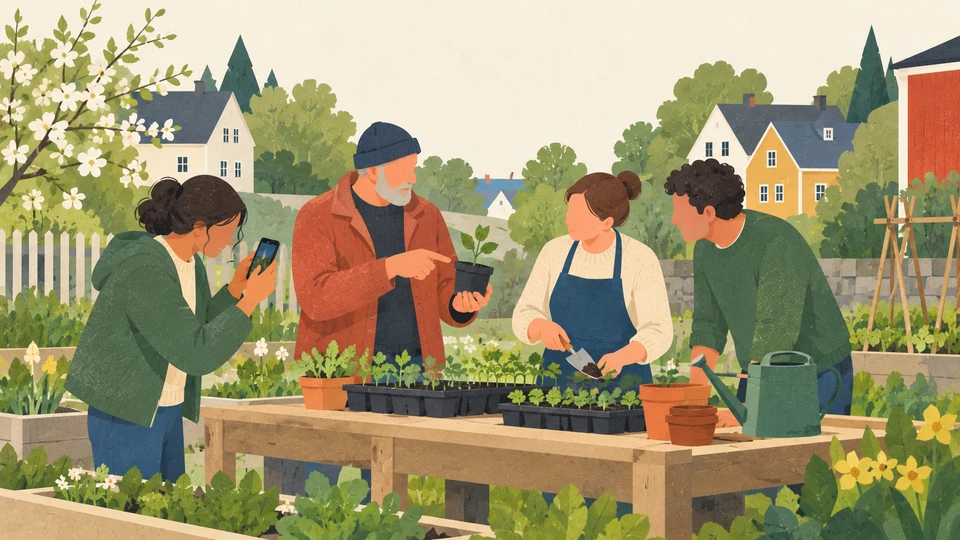
At Volda Learning Centre, a garden became a setting for language learning. In a January 2021 interview, teacher Gunnar Andenes described learners photographing plants and activities, writing words and recording their voices to make digital dictionaries. He explained how practical situations could support work on vocabulary and grammar. He also acknowledged that learning outcomes were difficult to measure and that gardening suited some participants better than others. The example shows a concrete teaching approach without making it a universal recipe.
Literature provides another meeting place. In a September 2024 account, Ørsta teacher Inghild Lillebø-Voll described adult learners reading parts of Erlend Skjetne’s novel Eit anna blikk and attending the related theatre production Blindsone. Preparation included discussing titles, characters and experiences, with learners using their other languages during reflection. Such activity places Norwegian learning within a wider linguistic repertoire and connects reading with performance and conversation. It also makes the contemporary life of Nynorsk visible beyond the history of its creation.
Sources
- Olaf Husby; Norwegian University of Science and Technology (NTNU), Norwegian on the Web. The Norwegian language. https://www.ntnu.edu/now/intro/background-norwegian
- National Centre for Education in Norwegian Nynorsk (Nynorsksenteret), Volda University College; historical introduction attributed to Lars S. Vikør. In English. https://nynorsksenteret.no/om-nynorsksenteret/in-english
- NRK. Språkregler (bokmål). https://sprak.nrk.no/rettleiing/bokmal/
- University of Bergen Library. The Language Collections. https://www4.uib.no/en/university-library/the-special-collections/the-language-collections
- Bokmålsordboka and Nynorskordboka; University of Bergen and Language Council of Norway. About. https://ordbokene.no/eng/about
- Guro Kristin Gjøsdal; Nynorsksenteret; interview with Gunnar Andenes of Volda Learning Centre. «Visst skal våren kome!» (2021-01-25). https://nynorsksenteret.no/blogg/visst-skal-varen-kome
- Inghild Lillebø-Voll; Nynorsksenteret. Tankar og ord, haldningar og handlingar (2024-09-11). https://nynorsksenteret.no/blogg/tankar-og-ord-haldningar-og-handlingar