Languages & Culture
Ojibwe
Ojibwe names a connected range of Algonquian language varieties whose homelands centre on the Great Lakes and extend across parts of Canada and the United States. Anishinaabemowin is a widely used name, alongside local forms and names such as Ojibway, Ojibwa and Chippewa. The Ojibwe People’s Dictionary describes a chain of related varieties with differences in pronunciation, vocabulary and grammar. Understanding the label therefore starts with asking which community and variety a source represents.
Local names and continuing responsibilities
The dictionary’s principal coverage is Central Southwestern Ojibwe, associated with Minnesota, Wisconsin and Canadian border-lakes communities. That scope is narrower than the full range covered by the general label Ojibwe. A lesson or recording from this resource should not automatically be presented as the single form used throughout all Ojibwe-speaking communities.
Nipissing First Nation uses the form Anishinaabemwin on its public language page. Its account describes classes with fluent speakers, translation work on community documents, language in childcare and contributions to community newsletters. These activities show language functioning in relationships and institutions, with priorities determined locally. They also illustrate why using a community’s own terminology is more informative than imposing one spelling everywhere.
Historical pressure and community agency belong in the same account. Temagami First Nation’s language commission traces its mandate to a community resolution of March 2016. The resolution identifies colonial assimilation policies as a threat to language continuity and affirms the community’s resistance to that pressure. The commission’s stated responsibilities include developing goals with community input and supporting families and individual learners. This is a continuing collective undertaking, shaped by the people whose language is involved.
Documentation that keeps speakers visible
The Ojibwe People’s Dictionary grew from work by John Nichols and colleagues at the University of Minnesota. Its history connects the digital project with the 1995 dictionary Nichols co-authored with Earl Nyholm and with recordings of Elders. Collaboration with the Minnesota Historical Society brought photographs, objects and historical materials into the resource, alongside linguistic information.
The digital design preserves useful context. Audio is labelled with the speaker’s initials and linked to biographical information; regional labels help identify community-specific usage. The editors explain that isolated words and connected speech can have different intonation. They also warn that English translations of example sentences can be free translations, rather than word-for-word equivalents. These details help learners interpret the resource carefully and recognise the people behind it.
Its cultural resources include humorous stories told by the late Larry Amik Smallwood and recorded and transcribed by Michael Migizi Sullivan Sr. The project distinguishes the original recordings from edited versions published in book form. That distinction matters: a written edition and a recording document related, but not identical, presentations of a story. The collection also makes humour visible as a specific part of recorded language practice.
Preparing teachers and creating everyday opportunities
At Lac Courte Oreilles in Wisconsin, the Waadookodaading Ojibwe Language Institute describes immersion education alongside teacher preparation, curriculum development and assistance to other language programmes. Its account foregrounds parents, local community members and fluent speakers contributing stories and classroom vocabulary. Language work here involves building the people and materials needed to sustain education through Ojibwe.
Adult learning provides another route. In an October 2025 Seven Generations Education Institute interview, educator Robert Animikii Horton described a programme serving learners from surrounding Treaty 3 First Nations. He reported graduates taking language knowledge into their communities and into teaching roles, including with the Rainy River District School Board. These are the educator’s reported experiences, rather than a general guarantee about any course’s outcomes.
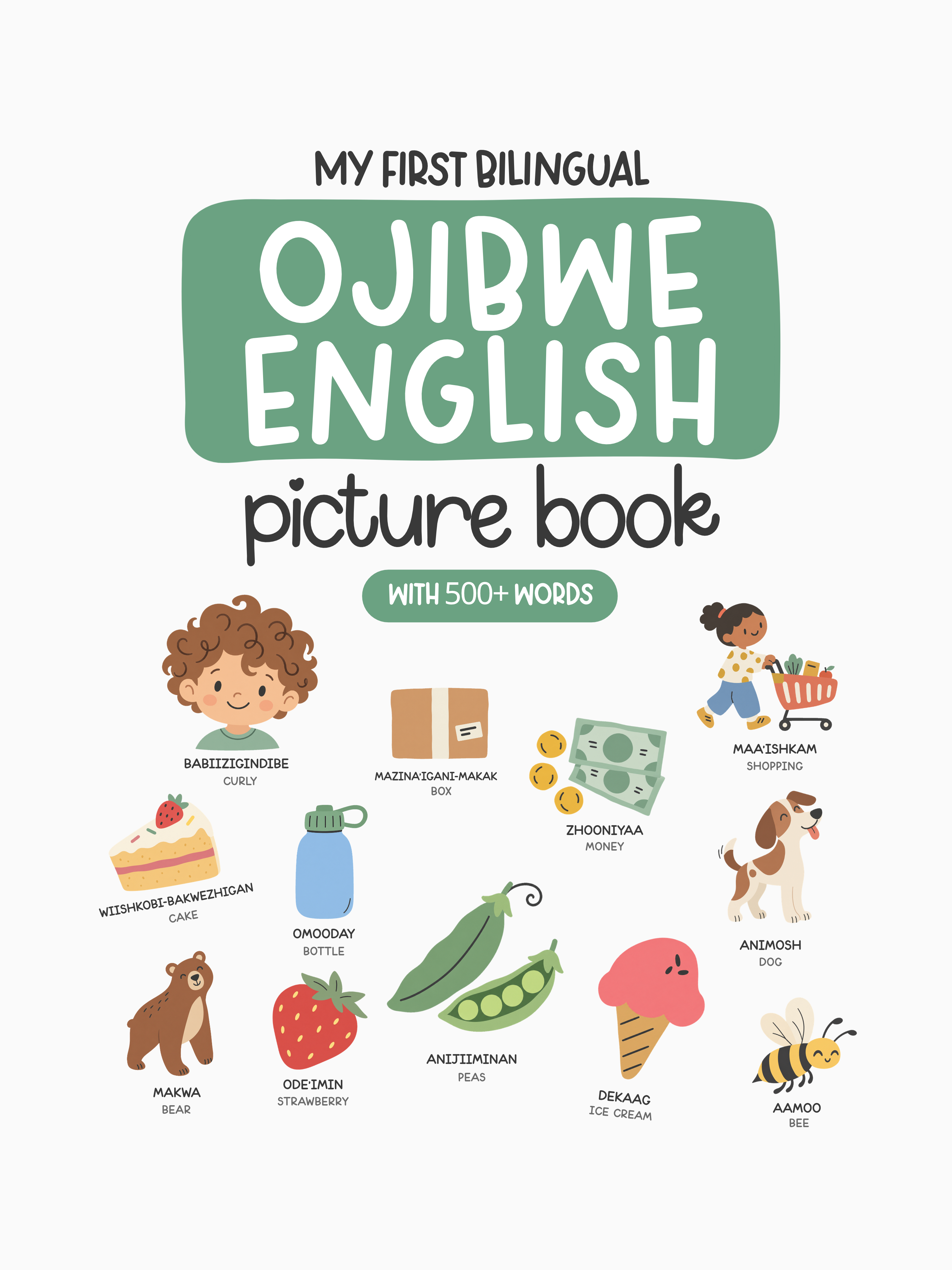
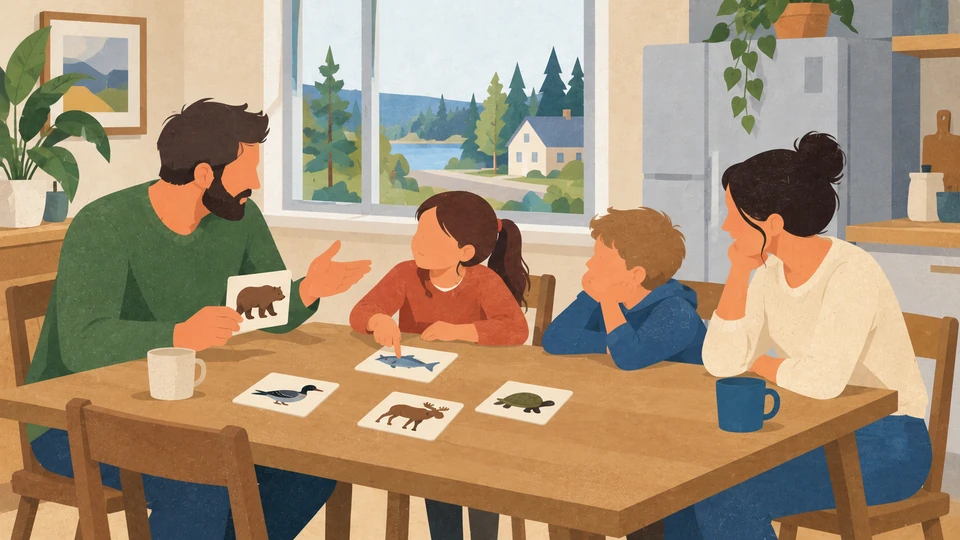
Home use is an explicit goal of Waking Up Ojibwe, whose partners include Seven Generations Education Institute and the Rainy River District School Board in Fort Frances, Ontario. Its family resources include songs, books and games developed with community guidance. Materials are editable to accommodate local knowledge and language variation. The games collection offers small-group activities involving animal pictures, everyday objects and vocabulary. Such resources give families concrete ways to make language part of ordinary interaction, while leaving room for their own speakers, relationships and routines.
Sources
- Ojibwe People’s Dictionary; University of Minnesota, American Indian Studies and University Libraries. About the Ojibwe Language. https://ojibwe.lib.umn.edu/about-ojibwe-language
- Ojibwe People’s Dictionary; University of Minnesota with Ojibwe speaker contributors. Ojibwe People’s Dictionary. https://ojibwe.lib.umn.edu/
- Nipissing First Nation, Culture & Heritage. Anishinaabemwin. https://nfn.ca/culture-heritage/anishinaabemwin/
- Temagami First Nation. Anishinaabemowin Sagaswe’idiwin (Language Commission). https://temagamifirstnation.ca/governance/language-commission/
- Ojibwe People’s Dictionary; University of Minnesota and Minnesota Historical Society collaborators. About the Ojibwe People’s Dictionary project. https://ojibwe.lib.umn.edu/about
- Ojibwe People’s Dictionary; editor Nora Livesay and founder/linguistic editor John D. Nichols identified in the page footer. Understanding Audio and Example Sentences. https://ojibwe.lib.umn.edu/understanding-audio-and-example-sentences
- Waadookodaading Ojibwe Language Institute. Who We Are. https://waadookodaading.org/whoweare/
- Seven Generations Education Institute; interview with Robert Animikii Horton; individual article writer not identified in accessible text. How SGEI’s Anishinaabemowin revitalization program is developing speakers who are more than just conversationally comfortable (2025-10-29). https://www.7generations.org/how-sgeis-anishinaabemowin-revitalization-program-is-developing-speakers-who-are-more-than-just-conversationally-comfortable/
- Waking Up Ojibwe / Anishinaabemodaa; Seven Generations Education Institute, Rainy River District School Board and SayITFirst; page editing byline Jordan Danielsson. Families. https://www.wakingupojibwe.ca/resources/families/
- Waking Up Ojibwe / Anishinaabemodaa; page byline Carissa Copenace. Odaminodaa! Let’s Play!. https://www.wakingupojibwe.ca/resources/families/odaminodaa-lets-play/