Languages & Culture
Panamanian Spanish
Panamanian Spanish encompasses regional varieties of Spanish used across Panama, from the capital and other towns to rural communities. Spanish belongs to the Romance language family; the Panamanian label identifies a national setting within that language. Research on local pronunciation and social attitudes reveals variation that a single national accent cannot capture.
Routes across the isthmus
The history of Spanish in Panama is connected to colonial settlement and routes between oceans. Panama's 2015 heritage nomination for its historic capital dates the Spanish city's foundation to 1519. It describes Panama City as a meeting point for Pacific and Atlantic communications, with connections to Portobelo on the Caribbean side. The same account recognises the forced African diaspora associated with the slave trade and encounters among Indigenous, African and European languages and cultures.
This history gives contact an essential place in the story of Spanish on the isthmus. It does not make every local speech feature traceable to a single historical encounter. To understand particular pronunciations or word meanings, researchers also need evidence from speakers and texts: where a form occurs, who uses it and in what circumstances.
Mapping speech and social judgments
In a 2022 study, Johnatan E. Bonilla reanalysed pronunciation maps from Panama's multidimensional linguistic atlas. The underlying phonetic research sampled nineteen localities and included younger and older speakers. Bonilla compared mapped features computationally and proposed five dialect areas within broader groupings. These are research findings from a particular dataset, rather than permanent boundaries separating everyone in neighbouring towns.
The analysis includes differences in whether the sound written with the letter s is retained or lost before another consonant. Looking at such environments makes pronunciation more informative than a broad impression of how an accent sounds. The atlas also allows comparisons across places instead of assuming that speech in the capital represents the whole country.
Attitudes are another part of this landscape. Tarahy Tinoco's study, published in 2014, interviewed people born in the capital or long resident there. Questions included preferences for accents in broadcasting and advertising. Respondents' explanations brought out concerns with familiarity and clear communication. These answers record listeners' judgments in that sample; they cannot establish that one population speaks inherently better Spanish. They also remind readers to distinguish a pronunciation pattern from the social reputation attached to it.
Words recorded and discussed
Local vocabulary has its own documentary history. In a 2022 essay published through the Academia Panameña de la Lengua, Edgardo Aguilar describes Margarita Vásquez's Diccionario del español en Panamá. Its evidence includes informative, narrative, conversational and literary texts. That range matters: a word encountered at home may have a different setting from one in a newspaper or a novel. Aguilar presents a dictionary as an attempt to document uses and their histories, with room for further recording.
Such work also enters public discussion. The Academy reported a conversation about Panamanian speech at the International Book Fair on 16 August 2024. Lexicographers explained their research, and audience members asked about vocabulary from places in the interior. The event shows how local knowledge can prompt questions for documentation, while a published dictionary makes accumulated research available for readers to consult.
Verse moving from page to voice
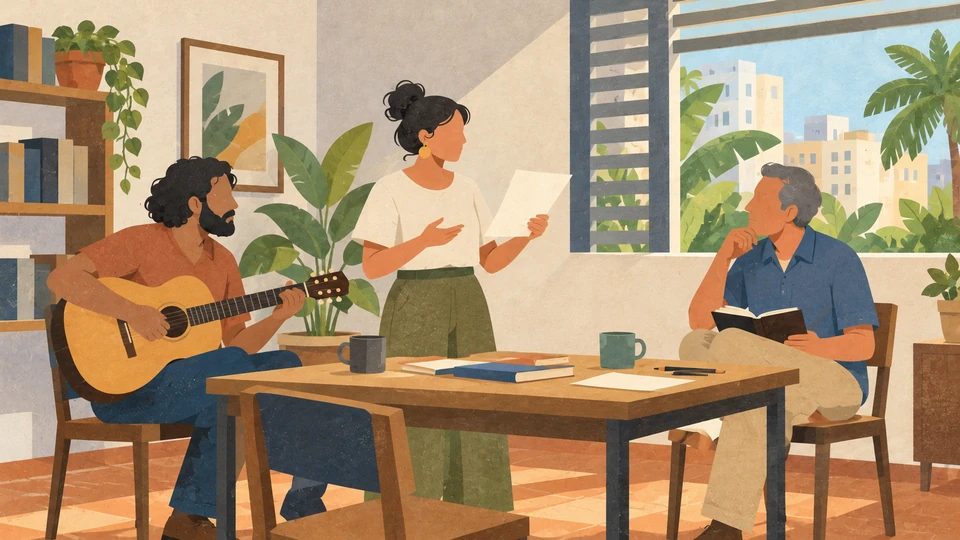
The décima offers a specific example of language used through writing, memory and performance. A June 2015 report from the Universidad Tecnológica de Panamá describes an activity encouraging students to compose this verse. Its account distinguishes the composer from the performer, who memorises the words and sings them with guitar accompaniment.
The report calls the accompanying melodic style a torrente. Following those stages of composition, memorisation and singing brings attention to the work involved in performance. A written poem is also material for a voice and an audience, and a university's invitation to students to write it places that practice within contemporary cultural education.
Sources
- Indiana University, Center for Language Technology. Spanish. https://celt.indiana.edu/portal/Spanish/index.html
- Permanent Delegation of Panama to UNESCO; hosted by UNESCO World Heritage Centre. Archaeological Site and Historic Centre of Panamá City. https://whc.unesco.org/en/tentativelists/5970
- Johnatan E. Bonilla; Moderna språk 116(1), 191–216. Análisis dialectométrico del nivel fonético del Atlas Lingüístico Pluridimensional de Panamá (2022). https://biblio.ugent.be/publication/8760254/file/8760255.pdf
- Tarahy Tinoco, Universidad de Panamá; Bergen Language and Linguistics Studies 5. Actitudes lingüísticas en Panamá. Incursión en la percepción sociolingüística y la valoración de la lengua por los hispanohablantes panameños (2014-11-04). https://bells.uib.no/index.php/bells/article/view/690/680
- Edgardo Aguilar; La Prensa, La Voz de la Academia; republished by Academia Panameña de la Lengua. De las palabras y los diccionarios (2022-08-18). https://aplengua.org.pa/de-las-palabras-y-los-diccionarios/
- Javier Alvarado; Academia Panameña de la Lengua. CONVERSATORIO EN TORNO A LA LENGUA Y EL HABLA PANAMEÑA. https://aplengua.org.pa/conversatorio-en-torno-a-la-lengua-y-el-habla-panamena-2/
- Universidad Tecnológica de Panamá; Spanish coordination, Faculty of Science and Technology. La Décima un baluarte de nuestra Identidad (2015-06-16). https://utp.ac.pa/la-decima-un-baluarte-de-nuestra-identidad