Language & culture
Papiamento: the language of Aruba, Bonaire and Curaçao
Language at a glance
- Estimated speakers
- About 300,000 · published 2013
ABC islands/diaspora; first-language share unspecified.
- Names
- Papiamento · Papiamentu
Aruba; Curaçao and Bonaire, respectively.
- Communities
- Aruba · Bonaire · Curaçao
Also the Netherlands and other diaspora communities.
- Type
- Iberian-based creole
Portuguese, Spanish and Dutch vocabulary.
- Writing
- Aruba: 27 letters; Curaçao: 26 base
Latin; Curaçao counts modified letters separately.
- Varieties
- Aruban · Curaçaoan · Bonairean
Aruba and Curaçao/Bonaire use distinct spellings.
Who speaks Papiamento, and what do they call it?
Papiamento is spoken in Aruba, Bonaire and Curaçao and abroad, including the Netherlands. It is called Papiamento in Aruba and Papiamentu in Curaçao and Bonaire: regional forms of the same language.
How many people speak Papiamento worldwide?
An estimate published in 2013 put speakers across the ABC islands and diaspora at about 300,000. It does not separate first-language speakers from others.
Where did Papiamento come from, and who spoke it in the past?
Papiamento emerged in seventeenth-century Curaçao amid European colonial rule and the Atlantic slave trade. Speakers included enslaved Africans, free people of African descent, Sephardic Jews and descendants of Dutch colonists. This Iberian-based creole draws much of its vocabulary from Portuguese and Spanish, with substantial Dutch contributions.
A surviving letter fragment from Curaçao dates to 1775; it records an already spoken language.
Which Papiamento words might an English speaker already recognise?
Aruban bais, meaning bicycle, comes from English bicycle. Borrowings such as computer and website retain familiar spellings.
How does Papiamento vary from region to region?
Island varieties differ in vocabulary, pronunciation and spelling. A recurring contrast is Aruban final -o where Curaçao and Bonaire have -u, as in the language’s name. Curaçao also has a Sephardic Jewish variety with distinctive vocabulary.
What is Standard Papiamento, and where is it used?
Aruba and Curaçao/Bonaire have different spelling traditions, used in education and public writing. Aruba’s spelling often preserves historical connections; Curaçao and Bonaire follow sounds more closely. “House” is cas in Aruba and kas in Curaçao.
Bonaire’s Regla di Ortografía di Papiamentu 2009 applies to government documents and publicly funded schools and courses.
Which alphabet does Papiamento use, and what might surprise an English speaker?
Both use Latin letters, with different inventories:
- Aruba’s 2009 Ortografia di Papiamento lists 27 letters, including ñ, plus four separately listed digraphs: ch, dj, sh, zj.
- Curaçao’s 2007 Ortografia di Papiamentu lists 26 base letters, with è, ò, ù, ü and ñ listed separately as modified letters, and the same four digraphs.
In Curaçaoan writing, an acute accent can mark stress; other vowel marks distinguish sounds.
Does Papiamento have grammatical gender?
Papiamento has no masculine or feminine noun classes.
How do you say hello, thank you and goodbye in Papiamento?
In Aruba:
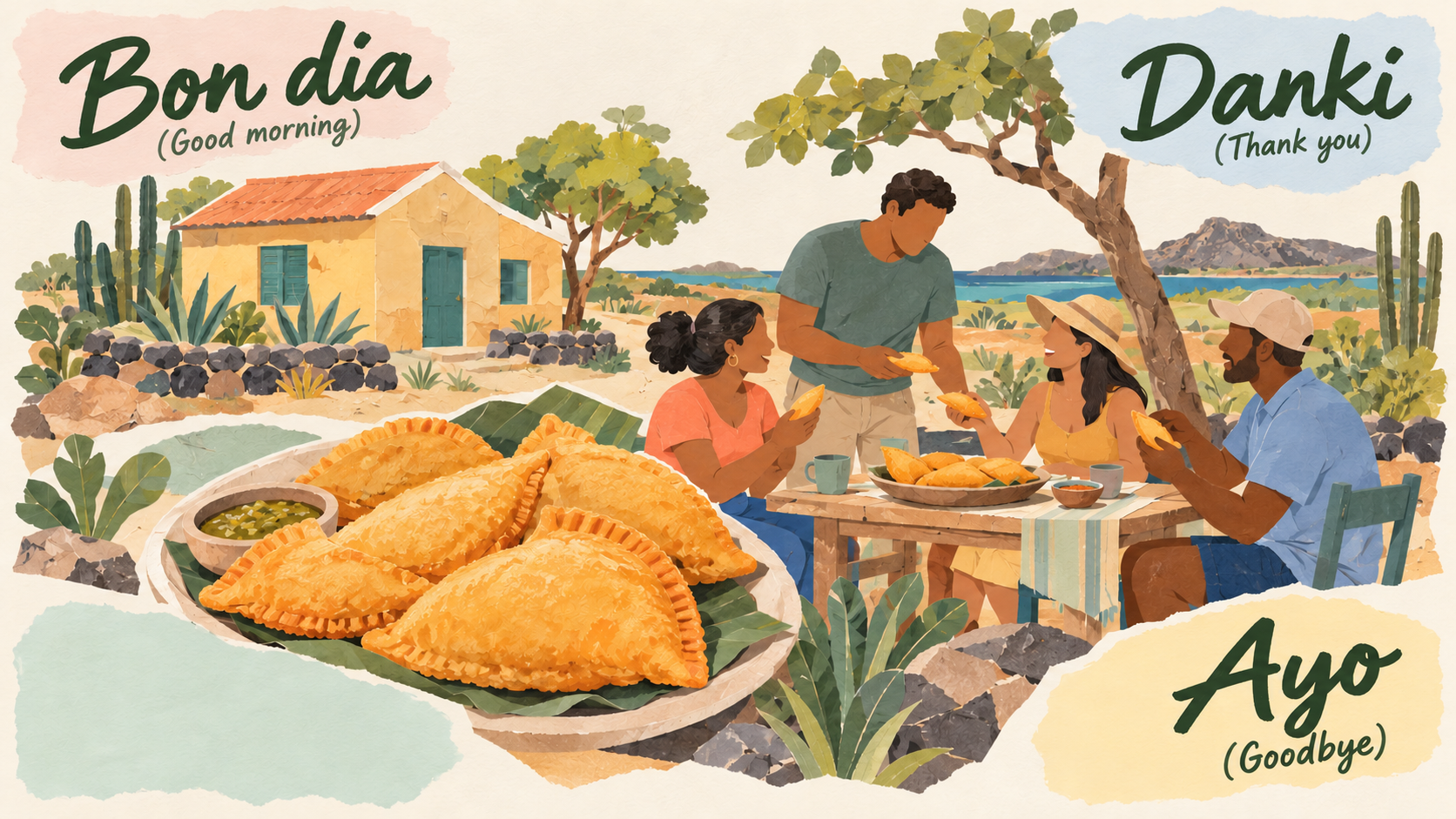
- Bon dia — good morning; a morning hello.
- Danki — thank you.
- Ayo — goodbye.
The corresponding afternoon and evening greetings are Bon tardi and Bon nochi.
What are some memorable Papiamento sayings?
- Primiti ta debe — a promise creates an obligation. It presents giving one’s word as taking on a debt.
- Biba, laga biba — live and let live, an appeal to allow others their own lives.
- Bati bleki — gossiping, with the image of beating cans.
What everyday customs might surprise a visitor?
In Curaçao, Bon siman! means “Have a good week!” This greeting can accompany “good morning” or “good afternoon” on Sunday or Monday.
Which Papiamento-language song and film offer a cultural introduction?
Izaline Calister’s Wow’i kariño, from Krioyo (2004), is a Papiamentu love song in the zouk antiano style. Randal Corsen wrote the music and Calister the lyrics, which appear with an English translation on her website.
Eché Janga’s Buladó (2020), written with Esther Duysker, follows eleven-year-old Kenza in rural Curaçao. Her father’s practical outlook clashes with her grandfather’s spiritual outlook. The film combines family life with magical realism and includes Papiamento and Dutch dialogue. An English-subtitled version featured in the New York International Children’s Film Festival’s 2021 programme.
What is available for someone curious about the language now?
- Aruban spelling: the Department of Education’s 2009 Ortografia di Papiamento and Vocabulario di Papiamento are PDFs of spelling rules and written forms.
- Curaçaoan spelling: the government’s 2025 compilation includes the FPI’s 2007 Ortografia di Papiamentu and Lista di palabra Papiamentu: rules and a word list.
- Historical reading: E. A. L. Hassell’s 1953 English–Papiamentu dictionary has digitised full text through Coleccion Aruba and Internet Archive, in period spelling. Coleccion Aruba also offers books, newspapers and audio.
Fun Facts
- Pitch carries meaning. In Curaçaoan Papiamentu, papa can refer to porridge or daddy. Its tone pattern makes the difference; ordinary spelling does not show that contrast.
- A name can include companions. Curaçaoan Marianan means Maria together with her family or friends.
Sources
- Philippe Maurer; APiCS Online. Papiamentu (Survey chapter). 2013.
https://apics-online.info/surveys/47 - Statistics Netherlands (CBS). What percentage of the population speaks Dutch? The Caribbean Netherlands in numbers 2022. 2022; survey reference year 2021.
https://longreads.cbs.nl/the-caribbean-netherlands-in-numbers-2022/what-percentage-of-the-population-speaks-dutch/ - Bart Jacobs. Thoughts on the linguistic history of Curaçao: how Papiamentu got the better of Dutch. 2013.
https://www.persee.fr/doc/rbph_0035-0818_2013_num_91_3_8468 - Tara Sanchez; University of Hawaiʻi, Language Varieties. Papiamentu. n.d.
https://www.hawaii.edu/satocenter/langnet/definitions/papiamentu.html - Departamento di Enseñansa Aruba. Ortografia di Papiamento. April 2009; web version May 2015.
https://www.ea.aw/pages/wp-content/uploads/pdf/doc-pub/p/papiamento_ortografia-april-2009-v-150520.pdf - Government of Curaçao; Fundashon pa Planifikashon di Idioma. Landsbesluit schrijfwijze Papiamentu en Nederlands, consolidated text; appended Ortografia di Papiamentu and Lista di palabra Papiamentu. 2025; appended works dated 1 March 2007.
https://gobiernu.cw/wp-content/uploads/2025/12/196-GT.-Lb-schrijfwijze-Papiamentu-en-Nederlands.pdf - Eilandsraad Bonaire. Verordening schrijfwijze Papiaments. 14 February 2013; effective 6 December 2013.
https://lokaleregelgeving.overheid.nl/CVDR359196/1 - Aruba Tourism Authority. The Official Languages of Aruba. n.d.
https://www.aruba.com/uk/our-island/island-facts/language - E. A. L. Hassell; Lago Oil and Transport Co.; digitised by Biblioteca Nacional Aruba. Dictionary English Papiamentu – Papiamentu English. June 1953.
https://archive.org/details/BNA-DIG-LAGO-DICTIONARY-1953 - VisitAruba / CaribMedia. Bati Bleki. n.d.
https://www.visitaruba.com/about-aruba/aruba-news/bati-bleki/ - Carolina Gomes-Casseres; contribution credited to Charis González-de Haseth. 913. It’s Always a Good Week in Curaçao. 24 September 2012.
https://1000awesomethingsaboutcuracao.com/2012/09/24/913-its-always-a-good-week-curacao/ - Izaline Calister. Krioyo. album 2004; webpage n.d.
https://www.izalinecalister.com/cds/krioyo.html - Izaline Calister; music and arrangement by Randal Corsen. Wow’i kariño: lyrics and English translation. n.d.
https://www.izalinecalister.com/cds/lyrics/wowikarino.html - Izaline Calister. Soundsamples. n.d.
https://www.izalinecalister.com/music/ - Keplerfilm. Buladó. film 2020; webpage n.d.
https://keplerfilm.com/work/bulado/ - New York International Children’s Film Festival. Buladó. 2021 programme; film 2020.
https://nyicff.org/programs/bulado/ - Departamento di Enseñansa Aruba. Vocabulario di Papiamento. 2009.
https://www.ea.aw/pages/wp-content/uploads/pdf/doc-pub/p/papiamento_Vocabulario-di-Papiamento-2009.pdf - Coleccion Aruba. Home PA. n.d.; accessed 23 October 2026.
https://coleccion.aw/pages/pa/home/ - Rijksdienst Caribisch Nederland. Papiamentu in the Netherlands recognised under Charter. 4 July 2024.
https://english.rijksdienstcn.com/latest/news/2024/july/4/papiamentu-in-the-netherlands-recognised-under-charter
Start learning today
Explore these books to keep learning.