Languages & Culture
Persian
Persian links communities in Iran, Afghanistan and Tajikistan, alongside Persian-speaking communities in Uzbekistan and a wider diaspora. Farsi, Dari and Tajik are important regional names within this shared linguistic history. Persian belongs to the Iranian branch of the Indo-European family. Here, the name covers that wider language and literary world, while recognising differences among national standards and local speech.
A changing written tradition
The history of Persian reaches beyond the modern national map. Linguist Ludwig Paul describes Early New Persian as the language's first phase after the Islamic conquest of Iran, approximately the eighth to twelfth centuries. Persian documents in Arabic script emerged during the ninth and tenth centuries, continuing Middle Persian through a gradual process of change. The transition involved a new script and changed political circumstances, alongside continuity in the inherited language.
Paul also cautions against imagining a single, permanently fixed classical standard. Writers such as Ferdowsi, Saʿdi and Hafez established influential styles at different times, and the language continued developing. This perspective helps explain why a long literary tradition can contain both continuity and differences that need interpretation. An older text has its own vocabulary, genre and historical setting.
Persian's geographical reach was similarly extensive. The University of Chicago's programme overview describes its historical use for literature and administration across Central and South Asia and beyond. Scholars use the English term Persianate for areas shaped by Persian language and literary, political or administrative culture. That cultural geography extends beyond a single nation and does not mean that everyone within it spoke Persian at home.
Several ways of putting Persian on the page
Written Persian has taken different visual forms. The Library of Congress's exhibition on Persian books describes the adaptation of Arabic script and the use of Hebrew script among Persian Jewish communities. Today, Iranian and Afghan Persian use Perso-Arabic writing, while Tajik uses a modified Cyrillic alphabet. A common literary relationship therefore does not automatically give a reader access to every printed form of the language.
That practical problem is an active research topic. In a February 2025 preprint, Rayyan Merchant, Akhilesh Kakolu Ramarao and Kevin Tang tested computational transliteration between Tajik Cyrillic and Perso-Arabic writing. They used paired texts to evaluate the conversion. Their work shows why replacing individual letters is insufficient: information represented in one writing system may need to be recovered from context in the other.
The authors report remaining difficulties, particularly in recovering vowels and grammatical links when converting into Tajik. They propose further data collection and development. The study is a research contribution, with stated limits, rather than evidence that automatic conversion already removes every barrier between readers. Its focus makes script knowledge part of the discussion of access to Persian texts.
Poetry shared at home
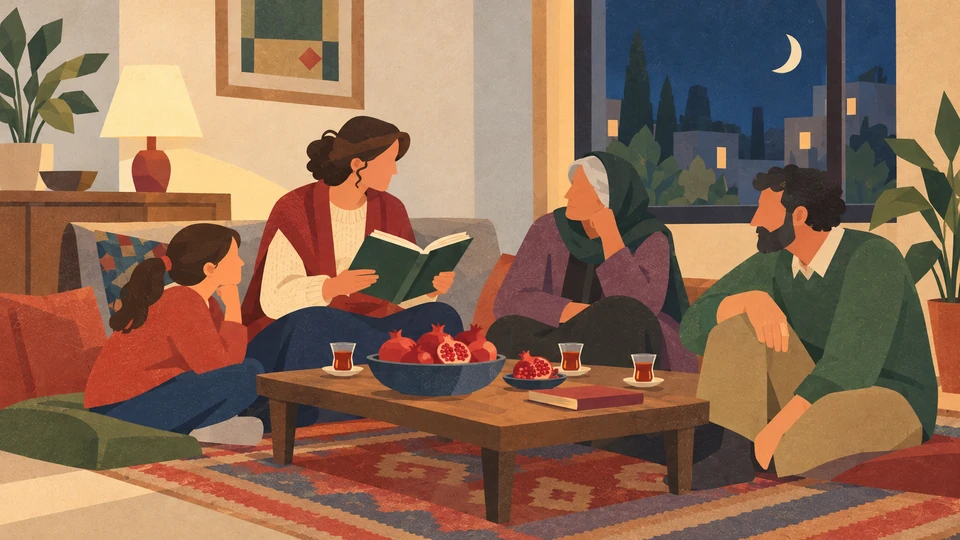
Literary language also lives through occasions for reading and listening. UNESCO's 2022 description of Yaldā/Chella, a practice in Iran and Afghanistan, places family gatherings on the last night of autumn. A table may hold a lamp and red fruits; activities include poetry, storytelling, games and music. The account describes informal transmission within families, connecting spoken performance with a recurring social occasion.
One personal account adds a smaller-scale perspective. In Boston University's cultural-sharing series, Siavash Behbahani describes gatherings of family and friends with pomegranates and a book of Hafez’s poetry on the table. This is an individual's account of his Persian culture, not a uniform rule for all Persian-speaking households. It illustrates how a named writer can remain part of present-day sociability as well as literary study.
Learning through different settings
Organised teaching can connect these modes of language use. Chicago's programme identifies Iranian standard Persian as its teaching variety while offering further study in media, literary translation and modern writing. Alongside coursework, its description lists a lunchtime conversation table, film discussions and Persian-language talks followed by questions. These activities give learners occasions to practise colloquial conversation and engage with more formal material, with the regional teaching focus made explicit.
Sources
- Library of Congress. The Persian Language - A Thousand Years of the Persian Book. https://www.loc.gov/exhibits/thousand-years-of-the-persian-book/persian-language.html
- Ludwig Paul; Encyclopaedia Iranica. PERSIAN LANGUAGE i. Early New Persian. https://www.iranicaonline.org/articles/persian-language-1-early-new-persian/
- Library of Congress. Writing Systems and Scripts - A Thousand Years of the Persian Book. https://www.loc.gov/exhibits/thousand-years-of-the-persian-book/writing-systems-and-scripts.html
- University of Chicago, Department of Middle Eastern Studies. Persian Language Program. https://mes.uchicago.edu/languages/persian-language-program
- Rayyan Merchant, Akhilesh Kakolu Ramarao and Kevin Tang. Connecting the Persian-speaking World through Transliteration. https://arxiv.org/pdf/2502.20047
- UNESCO. Intangible Cultural Heritage: UNESCO inscribes 47 elements. https://www.unesco.org/en/articles/intangible-cultural-heritage-unesco-inscribes-47-elements
- Siavash Behbahani; Boston University Chobanian & Avedisian School of Medicine, Radiology. Behbahani, Siavash Culture. https://www.bumc.bu.edu/radiology/education/extracurricular/art-in-the-department/celebrating-my-culture/behbahani-siavash-culture/