Language & culture
Plains Cree: A Language of Saskatchewan and Alberta
Language at a glance
- Speakers
- 12,005 · Canada census, 2021
People in private households reporting conversational ability.
- Local name
- nêhiyawêwin
Northern Plains Cree also has nîhiyawîwin.
- Communities
- Saskatchewan and Alberta
Muskeg Lake, Thunderchild, Onion Lake, Sturgeon Lake.
- Family
- Algonquian
Western part of the Cree continuum.
- Writing
- Southern Plains Cree SRO: 17 symbols
14 base Latin letters; syllabics: separate syllabary.
- Varieties
- Northern and southern Plains Cree
Y-dialect; northern î can correspond to ê.
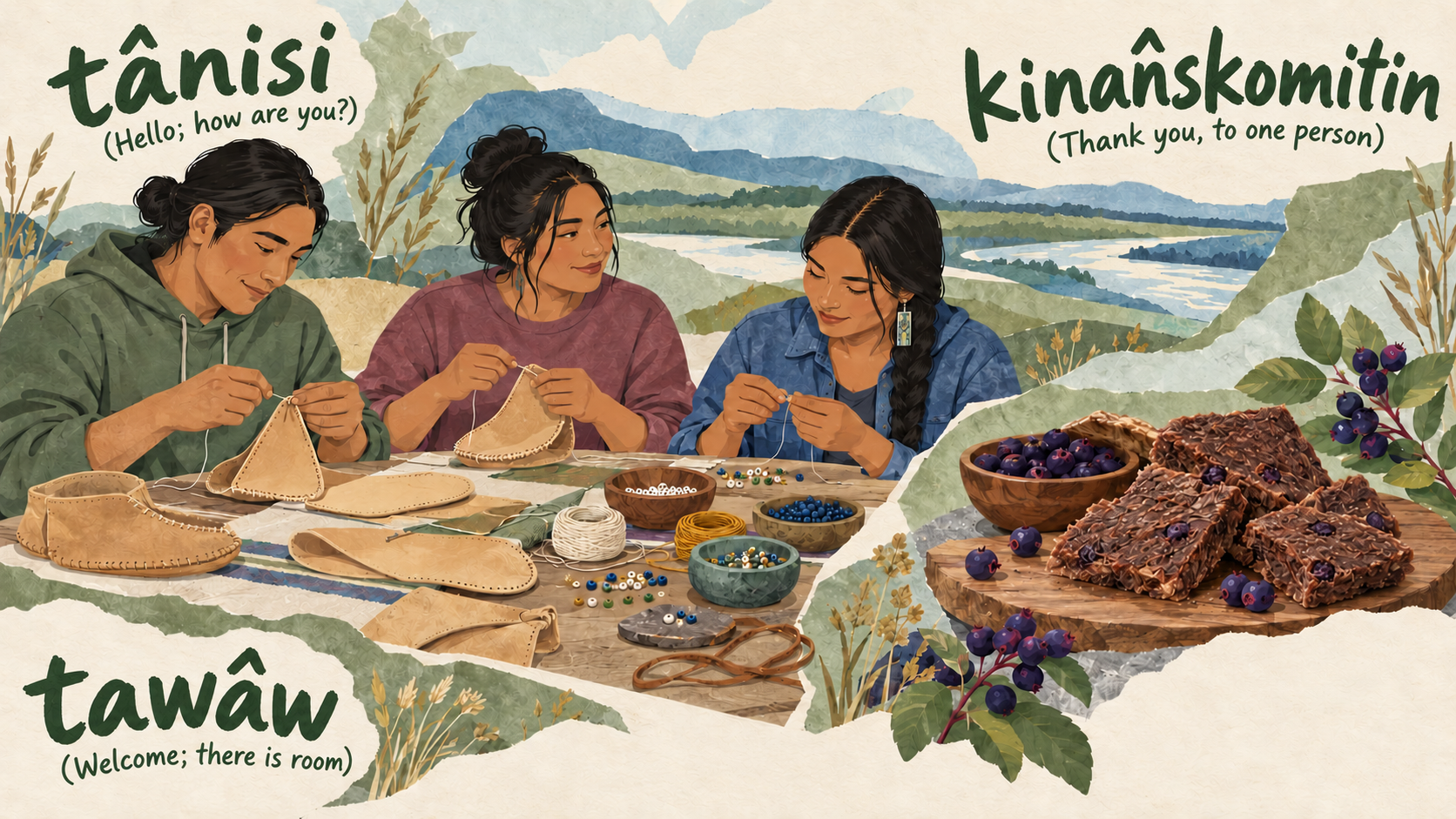
The greeting tawâw means welcome, with the literal sense that there is room.
Who speaks Plains Cree, and what do they call it?
Plains Cree, nêhiyawêwin, is spoken in southern and northwestern Saskatchewan and northern Alberta. Communities include Muskeg Lake, Thunderchild, Onion Lake and Sturgeon Lake. nêhiyawak names the Cree people; the language’s range includes forested country as well as plains.
How many people speak Plains Cree in Canada?
Canada’s 2021 census recorded 12,005 people in private households reporting conversational ability in Plains Cree, including childhood and later learners. Many other respondents reported only Cree, without naming a variety. A worldwide total remains uncertain.
Where did Plains Cree come from, and who spoke it in the past?
Plains Cree belongs to the Algonquian family and the western Cree language continuum. Its speakers’ history connects woodland and prairie communities. During the fur-trade era, southern Cree communities belonged to the Iron Confederacy with the Saulteaux and Assiniboine, trading with Indigenous peoples and English and French traders.
Its spoken history predates Albert Lacombe’s 1874 dictionary, an early substantial printed record of Plains Cree using French-based spelling.
Which Plains Cree words might an English speaker already recognise?
- Saskatoon, the berry name, comes from Cree misâskwatômina; the city was named after the plant.
- Kokum, grandmother in English, comes from Cree kôhkom, your grandmother. English use extends beyond that possessive meaning.
How does Plains Cree vary from region to region?
Northern and southern Plains Cree belong to the y-dialect: kiya means you. Northern î can correspond to southern ê, giving the language name nîhiyawîwin. Northern Plains Cree is distinct from Woods Cree, the th-dialect.
What is Standard Roman Orthography, and where is it used?
Standard Roman Orthography (SRO) provides consistent spellings while accommodating regional pronunciations. It appears in Jean Okimāsis and Arok Wolvengrey’s spelling guide, Plains Cree teaching materials and the itwêwina dictionary.
Which alphabet does Plains Cree use, and what might surprise an English speaker?
Southern Plains Cree SRO has 17 distinct symbols: ten consonants and seven vowels, using 14 base Latin letters. Vowel marks create distinctions beyond the base letters. Long vowels may take circumflexes or macrons: ê and ē mark the same long vowel, so both nêhiyawêwin and nēhiyawēwin occur. Plains Cree is also written in syllabics, a syllabary.
Does Plains Cree have grammatical gender?
Yes: animate and inanimate noun classes.
How do you say hello, thank you and goodbye in Plains Cree?
- tânisi — hello; also how are you?
- kinanâskomitin — I thank you, addressed to one person.
- mwêstas — later, also used when parting.
What are some memorable Plains Cree sayings?
Art Napoleon recalls two Northern Plains Cree sayings:
- konta wiya ôma pîkiskowin — roughly, that is only talk. Elders used it to challenge words unsupported by action.
- ikamâ konta ohci — roughly, there is a purpose to it. It reminds speakers that events have meaning and people should live in balance with nature.
What everyday customs might surprise a visitor?
Wayne Jackson recalls his family welcoming visitors and sharing despite poverty. Cree sacred stories about wîsahkêcâhk are associated with the snow-covered season. These âtayôhkêwina carry teachings or explain the world; Solomon Ratt retold them at winter Zoom gatherings in 2021.
Which Plains Cree-language song and film offer a cultural introduction?
Asiah Holm’s ôma askiy has a Plains Cree chorus translated by Jean Okimāsis and Arok Wolvengrey. The song concerns harm to the land and healing; the production includes Wolvengrey’s recorded pronunciation.
Tristin Greyeyes’s documentary A Cree Approach – nêhiyawîhtwâwin traces her language learning and the legacy of her grandmother, Cree scholar Freda Ahenakew, through interviews and archival footage. It uses English and Plains Cree; QWOCMAP’s festival presentation lists open captions.
What is available for someone curious about the language now?
- itwêwina is an online Cree–English dictionary recognising extended word forms, with recordings from Maskwacîs and Moswacîhk speakers.
- The Cree Literacy Network offers stories, poems, recordings and a PDF guide to the Plains Cree Stolen Words, with a bilingual glossary. The book follows a girl and grandfather recovering language lost through residential school.
- The University of Regina provides Jean Okimāsis’s Cree: Language of the Plains textbook as a PDF with SRO explanations and examples.
Fun Facts
- ocâpânimâwin covers relationships with both great-grandparents and great-grandchildren in Solomon Ratt’s account of Cree kinship.
- Okimāsis and Wolvengrey’s SRO guide uses lowercase even for names and sentence beginnings. Cree syllabics likewise has no separate capital forms.
Sources
- Statistics Canada and Office of the Commissioner of Indigenous Languages / Statistics Canada. Indigenous Language Families: Algonquian languages. 2025-03-31. https://www150.statcan.gc.ca/n1/pub/41-20-0002/412000022025002-eng.htm
- Solomon Ratt / First Nations University of Canada; hosted by Cree Literacy Network. mâci-nêhiyawêwin / Beginning Cree. 2012. https://creeliteracy.org/wp-content/uploads/2012/12/cree-text-2013-edition.pdf
- Saskatchewan Ministry of Education / Government of Saskatchewan. nēhiyawēwin 10, 20, 30 — Nature of nehiyaw Language. n.d. https://curriculum.gov.sk.ca/CurriculumDocument?id=2§ion=3186
- Jean Okimāsis and Arok Wolvengrey / Miywāsin Ink; hosted by Cree Literacy Network. How to Spell it in Cree (The Standard Roman Orthography). 2008. https://creeliteracy.org/wp-content/uploads/2016/01/htsiic-covers-nocontacts.pdf
- Solomon Ratt / Cree Literacy Network. Essential Phrases / Stay Home: Learn Cree. 2020-03. https://creeliteracy.org/wp-content/uploads/2020/03/EssentialPhrases.pdf
- Arden Ogg / Cree Literacy Network. Truth and Reconciliation for the Rest of the Year. 2024-10-01. https://creeliteracy.org/2024/10/01/truth-and-reconciliation-for-the-rest-of-the-year/
- Cree Literacy Network. Cree Literacy Network — Welcome. n.d. https://creeliteracy.org/
- Arden Ogg; retelling by Solomon Ratt / Cree Literacy Network. Wisahkecahk and the Rabbit (y-dialect). 2021-02-16. https://creeliteracy.org/2021/02/16/wisahkecahk-and-the-rabbit-th-dialect/
- Dolores Greyeyes Sand and Arden Ogg / Second Story Press; hosted by Cree Literacy Network. Guide to the Plains Cree Edition: kimotinâniwiw itwêwina / Stolen Words. 2021. https://creeliteracy.org/wp-content/uploads/2021/10/StolenWords_TeacherGuide_2021.pdf
- Alberta Language Technology Lab / University of Alberta. itwêwina: Plains Cree Dictionary. n.d. https://altlab.ualberta.ca/itwewina/
- Alberta Language Technology Lab and collaborating institutions / University of Alberta; First Nations University of Canada; Maskwacîs Education Schools Commission. itwêwina Plains Cree Dictionary. n.d. https://itwewina.altlab.app/
- First Nations University of Canada. Algonquian Atlas and Dictionaries Project. n.d. https://www.fnuniv.ca/academic/research-office/current-ongoing-research-projects/algonquian-atlas-and-dictionaries-project/
- Jean L. Okimāsis / University of Regina Press. Cree: Language of the Plains / nēhiyawēwin: paskwāwi-pīkiskwēwin. 2018. https://ctl.uregina.ca/assets/creelanguageoftheplainstextbook.pdf
- Art Napoleon / University of Victoria, MA thesis. Key Terms and Concepts for Exploring Nîhiyaw Tâpisinowin the Cree Worldview. 2014. https://dspace.library.uvic.ca/items/bef17704-d2aa-4063-8c3f-7fdd5d0f8ac7
- Kevin Brousseau (Kepin) / Kepin’s Cree Language Blog. Towards a Standard Orthography – Part 2. 2021-03-05. https://creelanguage.wordpress.com/2021/03/05/towards-a-standard-orthography-part-2/
- Neal McLeod / Indigenous Saskatchewan Encyclopedia, University of Saskatchewan; University of Regina Press resource. Cree. n.d. https://teaching.usask.ca/indigenoussk/import/cree.php
- Government of Saskatchewan. Saskatchewan Symbols, Emblems and Flags. n.d. https://www.saskatchewan.ca/government/visual-identity-and-protocol/emblems-and-flags
- Arden Ogg / Cree Literacy Network. Kokum Rap: Maria Campbell, Rita Bouvier, Maxine Roy, Louise Halfe with Zoey Roy. 2019-08-21. https://creeliteracy.org/2019/08/21/kokum-rap-maria-campbell-rita-bouvier-maxine-roy-louise-halfe-with-zoey-roy/
- Arden Ogg / Cree Literacy Network. ôma askiy: Asiah Holm. 2025-01-18. https://creeliteracy.org/2025/01/18/oma-askiy-asiah-holm/
- MacKenzie Art Gallery. RIFFA Screening: A Cree Approach – nêhiyawîhtwâwin. n.d. (2026 event programme). https://mackenzie.art/event/riffa-screening-a-cree-approach-nehiyawihtwawin/
- Regina International Film Festival & Awards / RIFFA Foundation. RIFFA 2026 – Day Four. n.d. (2026 festival programme). https://riffa.ca/riffa-2026-day-four/
- Queer Women of Color Media Arts Project / QWOCMAP. A Cree Approach. n.d. (2026 festival listing). https://qwocmap.org/films/festival/a-cree-approach/
- Megan Bontogon, Antti Arppe, Lene Antonsen, Dorothy Thunder and Jordan Lachler / The Canadian Modern Language Review; author version hosted by UiT Giellatekno. Intelligent Computer Assisted Language Learning (ICALL) for nêhiyawêwin: An In-Depth User-Experience Evaluation. 2018. https://giellatekno.uit.no/publications/Bontogon_et_al_ICALL_crk_2018.pdf
Start learning today
Explore these books to keep learning.