Language & culture
Plautdietsch: Mennonite Low German Across Borders
Language at a glance
- Speakers
- 447,360 (estimate quoted 2021)
Europe/Americas; first-language total unspecified.
- Names
- Plautdietsch
Also known as Mennonite Low German.
- Communities
- Europe and the Americas
Canada, USA, Latin America and Germany.
- Family
- West Germanic
Eastern Low German; Low Prussian branch.
- Writing
- 27 Latin letter forms
Copre/Zacharias Molotschna (2018): A–Z plus ä.
- Varieties
- Old Colony · Molotschna
Rempel and Zacharias use different spelling.
Who speaks Plautdietsch, and what do they call it?
Plautdietsch is the speakers’ own name for Mennonite Low German, spoken by Mennonites and their descendants in Canada, the United States, Mexico, Paraguay, Bolivia, Belize and Germany. Canadian communities include the Prairies and southwestern Ontario.
How many people speak Plautdietsch worldwide?
An estimate quoted in 2021 puts speakers at 447,360 across Europe and the Americas. It includes main-language users and people who retain Plautdietsch through family; a first-language total is not specified.
Where did Plautdietsch come from, and who spoke it in the past?
Plautdietsch belongs to Low Prussian, a branch of Eastern Low German within West Germanic. Sixteenth-century Mennonites seeking refuge from religious persecution settled in the Vistula delta, now Poland, adopting local Low German while retaining Netherlandic vocabulary.
From 1789, communities migrated to the Russian Empire, in what is now Ukraine, and later to the Americas. Earlier Mennonite writing often used Dutch or High German. J. H. Janzen was writing in Plautdietsch in the Russian Empire before the First World War, long after the language’s spoken beginnings.
Which Plautdietsch words might an English speaker already recognise?
Canadian Plautdietsch borrowed these words from English:
- Kottaluag — catalogue.
- Stua — store.
- Riefa — river.
Woata and English “water” are older relatives, sharing Germanic ancestry.
How does Plautdietsch vary from region to region?
Old Colony (Chortitza) and Molotschna are major traditions named for historic colonies in present-day Ukraine. Both have speakers in several countries.
Rempel writes “back” as Old Colony trigj and Molotschna tridj. Later contact brought English words into Canadian usage and Spanish words into communities connected with Latin America.
Is there a standard written form of Plautdietsch?
There is no single standard. Rempel’s dictionary largely follows Old Colony usage; Copre’s Molotschna grammar uses Ed Zacharias’s system. Written Plautdietsch appears in dictionaries, teaching materials, plays and stories. Arnold Dyck helped establish its Canadian literary tradition.
Which alphabet does Plautdietsch use, and what might surprise an English speaker?
Copre’s 2018 Molotschna spelling uses 27 letter forms when ä is counted separately: the 26 base Latin letters plus ä, excluding combinations such as sch. The letters q, x and y mainly occur in foreign words.
Rempel instead excludes q, v, x and y and uses ü. Nouns are capitalized, even within sentences.
Does Plautdietsch have grammatical gender?
Yes: masculine, feminine and neuter.
How do you say hello, thank you and goodbye in Plautdietsch?
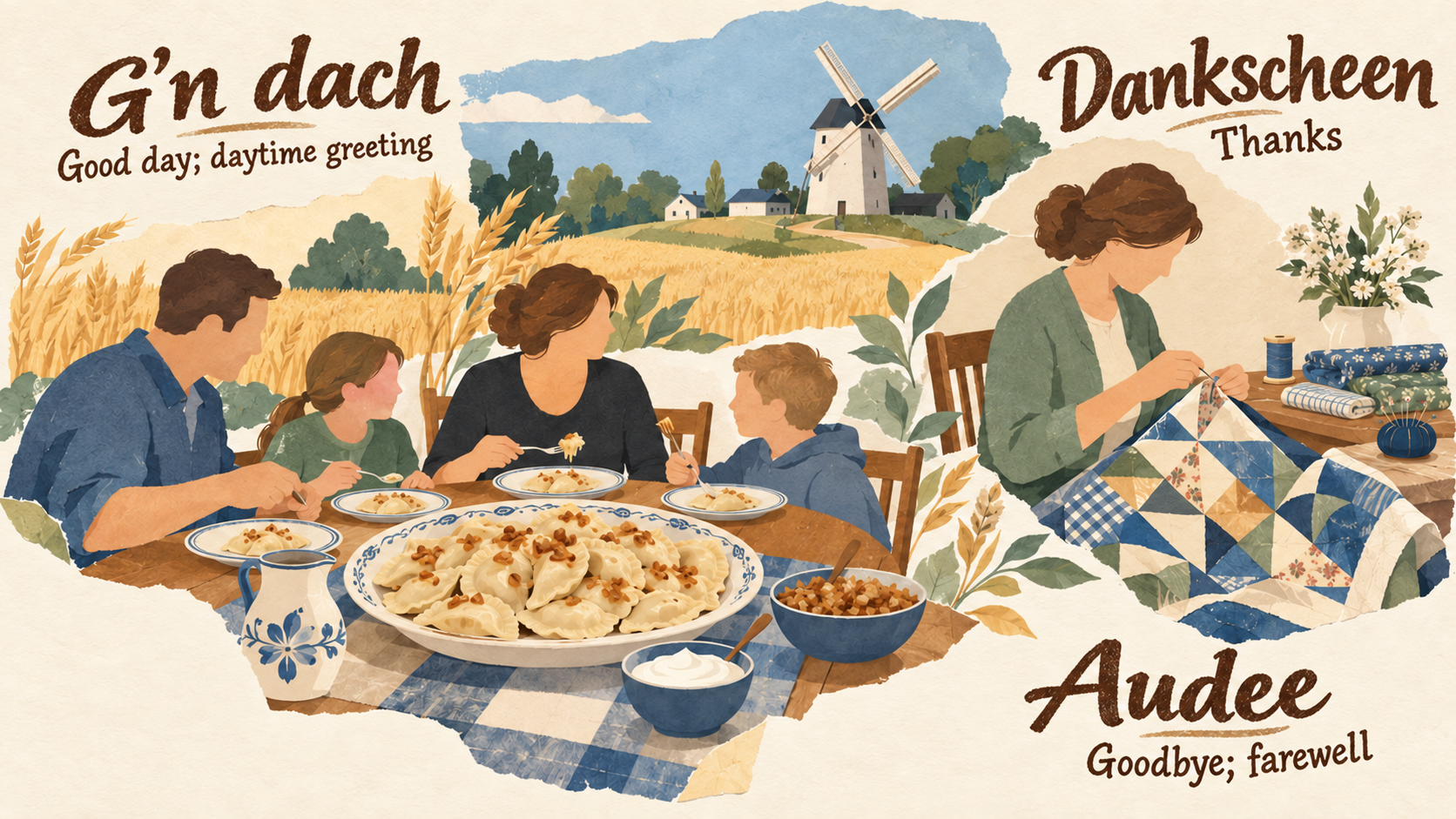
- G'n dach — good day; a daytime greeting.
- Dankscheen — thank you, or thanks.
- Audee — goodbye, or farewell.
What are some memorable Plautdietsch sayings?
Mennonite Heritage Village in Manitoba shared these sayings as encouragement during the pandemic:
- Fonn nuscht ess nuscht. Nothing will result if nothing is put into it.
- Et ess kjeene Schaund dol too faule, oba ligje bliewe ess. A setback is no disgrace; giving up after it is the problem.
What everyday customs might surprise a visitor?
In the Russian Mennonite tradition in North America, faspa is an unhurried Sunday afternoon meal and visit, often with bread, cheese and coffee. Visits can stretch into hours of conversation. Baking may be done on Saturday to leave Sunday for rest.
Which Plautdietsch-language song and film offer a cultural introduction?
De Droom (“The Dream”), sung by the Heide family in Mexico, tells of a father dreaming that he will be separated from his family after death. He wakes grateful for time to turn towards faith, a theme of their evangelical repertoire.
Carlos Reygadas’s Stellet Licht (Silent Light, 2007) follows a married farmer’s affair and resulting family and spiritual crisis in a Mennonite community near Chihuahua, Mexico. The film uses Plautdietsch dialogue; Film at Lincoln Center screened an English-subtitled version.
What is available for someone curious about the language now?
Herman Rempel’s Kjenn Jie Noch Plautdietsch? is free online, with wordlists in both directions between Plautdietsch and English. Plautdietsch.ca groups entries by initial letter and links them to his pronunciation recordings.
Copre’s Molotschna grammar is a readable PDF with English explanations, bilingual examples and exercises.
Fun Facts
- In one Canadian Old Colony variety, fuj (“yuck”) apparently contains a vowel combination found in no other word.
- goodjenüach means “good enough”, but es die daut goodjenüach? can challenge someone’s nerve when they disregard propriety.
Sources
- Christopher Cox, Jacob M. Driedger and Benjamin V. Tucker. “Mennonite Plautdietsch (Canadian Old Colony).” Journal of the International Phonetic Association 43(2), 2013, pp. 221–229; published online 5 July 2013.
https://www.cambridge.org/core/journals/journal-of-the-international-phonetic-association/article/mennonite-plautdietsch-canadian-old-colony/5DBF147D7FB105D2AD6FC69B6FE35D87 - Low German Speaking Mennonite Community of Practice of Elgin, St. Thomas, Oxford, and Norfolk. Working with Low German Speaking Mennonites: A Guide For Service Providers. Mennonite Community Services, February 2024.
https://www.mcson.org/wp-content/uploads/2024/06/Working-with-Low-German-Mennonites-v4.4-formatted.pdf - Herman Rempel; introduction by Reuben Epp. Kjenn Jie Noch Plautdietsch? Mennonite Low German Dictionary. Revised edition, 1995; copyright Herman Rempel and Mennonite Literary Society. Introduction and dictionary guide; web edition hosted by Eugene Reimer.
https://ereimer.net/plautdietsch/aa-intro-etc.htm - Herman Rempel. Kjenn Jie Noch Plautdietsch? Plautdietsch-to-English wordlist. Revised edition, 1995; web adaptation undated, hosted by Eugene Reimer.
https://ereimer.net/plautdietsch/pddefns.htm - Craig Steven Ostrander, compiler and editor; Scott Engel, Plautdietsch contributor; Lowlands-L contributors. The Germanic Phrasebook. First edition, March 1997; copyright 1997–2000.
https://www.bforest.com/germanicphrasebook/phrase.pdf - Film at Lincoln Center. Silent Light / Stellet Licht. Film listing for Carlos Reygadas’s 2007 film; 2017 retrospective.
https://www.filmlinc.org/films/silent-light/ - Plautdietsch.ca; Herman Rempel, recordings. Herman Rempel’s Pronunciation Exercise. Undated; project credits 1984, 1995 and 1998–2006.
https://www.plautdietsch.ca/PronunciationExercise.htm - D. E. Copre. Mennonite Low German Grammar, Molotschna Version / Plautdietsche Gramatikj, Molotschna Utgow. Ottawa, draft 16 June 2018; hosted by the Chortitza archive.
https://media.chortitza.org/pdf/viewer.php?file=FB/pdf/Mennonite+Molotschna+Grammat.pdf - Christopher Cox. “Plautdietsch in Canada.” Yearbook of German-American Studies, Supplemental Issue 6, 2025, pp. 37–78.
https://journals.ku.edu/ygas/article/download/24239/21614/88392 - John te Velde and Nora Vosburg. “Plautdietsch: A Remarkable Story of Language Maintenance and Change.” In Michela Russo, editor, The Emergence of Grammars: A Closer Look at Dialects between Phonology and Morphosyntax. Nova Science Publishers, 2021, pp. 377–440. Author-hosted manuscript.
https://vtevelde.com/john/Chapter%20on%20Plautdietsch-Final.pdf - William D. Keel. “From the Netherlands to Kansas: Mennonite Low German.” Heritage of the Great Plains 27, Summer 1994, pp. 39–50. Emporia State University repository.
https://esirc.emporia.edu/bitstreams/b46af1b1-11d2-4832-808d-a4002ae71f53/download - Gary Dyck. “Language Fun.” Mennonite Heritage Village, 21 October 2021.
https://mhv.ca/news/language-fun/ - Molly Wiebe Faber. “Faith formed by faspa.” Anabaptist World, 3 September 2024.
https://anabaptistworld.org/faith-formed-by-faspa/ - Judith Klassen. “You Call that ‘Christian’? Language Use and Evangelism in the Music of a Mennonite Family in Mexico.” MUSICultures 34/35 (2007–2008), pp. 1–25; online publication 18 February 2013.
https://journals.lib.unb.ca/index.php/MC/article/download/20257/23359/28614
Start learning today
Explore these books to keep learning.