Languages & Culture
Polish
Polish belongs to the West Slavic group, alongside Czech, Slovak and the Sorbian languages. It is Poland’s official language and is also used by communities across Europe, North America and elsewhere. That geography includes both people who inherit Polish at home and people who learn it later. Language ability should not be inferred from a surname, birthplace or appearance.
Its written history can be followed through surviving manuscripts, printed books and increasingly searchable digital collections. Together, these records show why present-day Polish needs both historical explanation and attention to variation: a medieval sermon, a newspaper report and a conversation offer different kinds of linguistic evidence.
Medieval words with an unexpected afterlife
The National Library of Poland describes the Holy Cross Sermons as the oldest surviving continuous prose text in Polish. The surviving manuscript was written in the fourteenth century; the composition may be older. Its recovery was unusually material: parchment strips carrying the sermons had been reused to reinforce the binding of a Latin manuscript. Aleksander Brückner identified them during research in St Petersburg in 1889–1890.
This is evidence about what survived, rather than a date on which people began speaking Polish. Written fragments require painstaking interpretation. The Polish Academy of Sciences’ Department of Old Polish still investigates possible sources, extracts Polish glosses and studies historical vocabulary in its Slavic context. A gloss—a word explaining another text—can therefore matter alongside a substantial literary manuscript.
Listening to usage through collections of texts
A language corpus gathers texts so researchers can examine words in context. The National Corpus of Polish brings together work by two Polish Academy of Sciences institutes, the publisher PWN and the University of Łódź. Its materials include literature, newspapers, specialist publications, conversational transcripts and internet texts. The project’s description stresses diversity of genre and subject, alongside variation in speakers’ ages and regions.
This matters for learners as well as researchers. A dictionary meaning alone does not reveal every setting in which a word appears. Context helps distinguish a phrase encountered in conversation from wording characteristic of a particular profession or publication. The corpus provides evidence for examining those differences; it is not a census of every Polish speaker.
Historical research faces an additional problem: the available texts are uneven. The KorBa project, developed by Polish Academy of Sciences researchers, collects seventeenth- and eighteenth-century Polish. Its creators explain that preserved literature is disproportionately available, while ordinary spoken exchanges cannot be recovered as recordings. They also describe grammatical categories that differ from modern Polish, requiring changes to the system used to annotate contemporary texts.
Reading the past therefore involves more than updating spelling. Researchers must identify what a form was doing in its own period, while remembering that the archive records only part of an earlier society’s communication.
Dictionaries that document diversity
The academy’s Wielki słownik języka polskiego, or Great Dictionary of Polish, is an online scholarly dictionary. In a 2014 paper, its editor Piotr Żmigrodzki described it as corpus-based and descriptive: its task is to document usage, rather than function simply as a list of approved forms.
The institute also documents dialect vocabulary and proper names, and participates in linguistic atlas projects. Standard Polish consequently sits within a wider field of research on regional and historical usage. These projects serve different purposes: a contemporary dictionary, a dialect dictionary and a medieval lexical resource should not be treated as interchangeable descriptions of how everyone speaks today.
Books become conversations
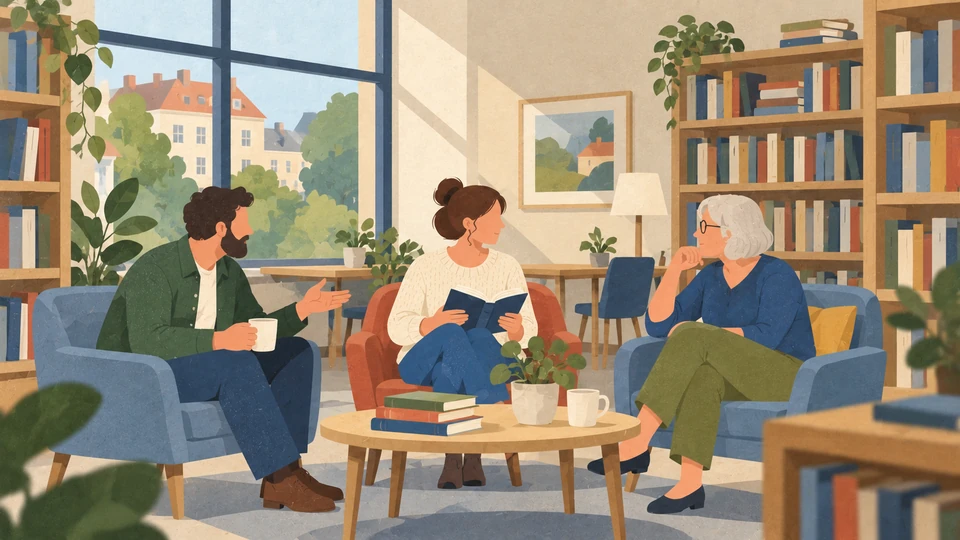
Reading also has a social life beyond dictionaries and archives. Biblioteka Kraków describes its discussion clubs as gatherings where a particular book starts an exchange about literature, authors and readers’ responses. It runs groups for adults and children, and explicitly presents the meetings as opportunities to form connections and a community.
Such a setting brings reading and speaking together. Participants can compare interpretations, explain disagreement and hear how someone else describes the same passage. It offers a concrete view of contemporary Polish culture: people using language to make sense of a text together, with room for different experiences and opinions.
Sources
- Institut national des langues et civilisations orientales (Inalco). Polish. https://www.inalco.fr/en/languages/polish
- National Library of Poland. New exhibition at the National Library: Brückner. The Middle Ages Recovered (2023-10-19). https://www.bn.org.pl/en/news/5120-new-exhibition-at-the-national-library-brueckner-the-middle-ages-recovered.html
- Institute of Polish Language, Polish Academy of Sciences. Department of Old Polish. https://ijppan.pl/en/pracownia/pracownia-jezyka-staropolskiego/
- National Corpus of Polish consortium: Institute of Computer Science and Institute of Polish Language, Polish Academy of Sciences; PWN; University of Łódź. About the NKJP Project. https://nkjp.pl/index.php?lang=1&page=0
- KorBa project; Institute of Polish Language and Institute of Computer Science, Polish Academy of Sciences. About the Corpus. https://korba.edu.pl/overview?lang=en
- Biblioteka Kraków. Dyskusyjne Kluby Książki. https://biblioteka.krakow.pl/kluby/dyskusyjne-kluby-ksiazki
- Polish Academy of Sciences. Institute of Polish Language of the Polish Academy of Sciences. https://pan.pl/en/facility/institute-of-polish-language-of-the-polish-academy-of-sciences/
- Piotr Żmigrodzki; Institute of Polish Language, Polish Academy of Sciences; Slovenščina 2.0, 2(2), pp.37–52. Polish Academy of Sciences Great Dictionary of Polish [Wielki słownik języka polskiego PAN] (2014). https://pliki.wsjp.pl/Slo2.0_2014_2_04.pdf