Languages & Culture
Portuguese
Portuguese connects communities across several continents, but it does not occupy the same place in everyone’s life. It can be a home language, a language learned at school, or one part of a multilingual repertoire. Its official status in a country tells us less about everyday conversation than a map of national borders might suggest.
Linguists describe Portuguese as pluricentric: it has more than one centre of standard usage. European and Brazilian Portuguese have established traditions of codification, while the recognition and description of other national varieties continue to develop. A general account therefore needs to leave room for different centres, rather than present one country’s usage as the whole language.
From Iberian history to international communities
Portuguese is a Romance language, descended from Latin. Its early development belongs to the northwestern Iberian Peninsula, encompassing present-day Galicia and northern Portugal. The Museu da Língua Portuguesa places this history within successive encounters among populations and languages, including contact with Arabic during the medieval period.
The museum’s account of linguist Ataliba Castilho’s explanation traces Portuguese through medieval Galician-Portuguese. The history is one of gradual differentiation, changing political boundaries and literary cultivation, not an isolated moment when a finished modern language appeared. The shared medieval background also helps explain why Galicia belongs in an account of Portuguese origins.
Portuguese subsequently travelled through colonial expansion, settlements and trading posts in Africa, Asia and the Americas. J. Clancy Clements’s account of this expansion emphasizes that contact changed both vocabulary and linguistic structure. Portuguese-based creole languages also developed, with grammatical systems of their own. They should not be treated simply as imperfect versions of Portuguese.
Official status and everyday choices
The present-day geography includes Portugal and Brazil, African settings such as Angola and Mozambique, and Asian settings including Timor-Leste and Macau. These places do not form one uniform speech community. In Timor-Leste, Portuguese shares official status with Tetum; in Macau, with Chinese. In Cabo Verde and Guinea-Bissau, official Portuguese coexists with creole languages central to everyday life.
These distinctions matter when choosing learning materials or interpreting a recording. The relevant questions include where someone uses Portuguese, with whom, and for what purpose. A national label alone cannot answer them, and a person’s command of Portuguese need not replace their use of another language.
Shared references that record difference
The Vocabulário Ortográfico Comum da Língua Portuguesa, managed by the International Portuguese Language Institute, provides a practical example of cooperation without erasing local usage. Its national vocabularies are assembled and checked by teams in the participating countries. Their entries feed into a common resource while retaining information about country-specific evidence. The site distinguishes forms directly attested in a country’s data from forms accepted there without that particular attestation.
A shared spelling resource does not settle every question about standards. In his 2024 study, Augusto Soares da Silva examines the tension between several national norms and a proposed overarching international norm. He argues for fuller recognition of multiple centres. This is a scholarly position within an ongoing debate, not evidence that all communities already follow an identical standard.
Research also proceeds locally. At Universidade Eduardo Mondlane, the Portuguese chair’s resource catalogue lists spoken and written collections from school pupils and university students in Mozambique, identified by place and collection period. It also lists a dictionary of Mozambican Portuguese verb constructions by Perpétua Gonçalves and Víctor Justino. Those specific populations and dates make the materials useful evidence; they do not turn them into a sample of all Portuguese worldwide.
Literature in shared public spaces
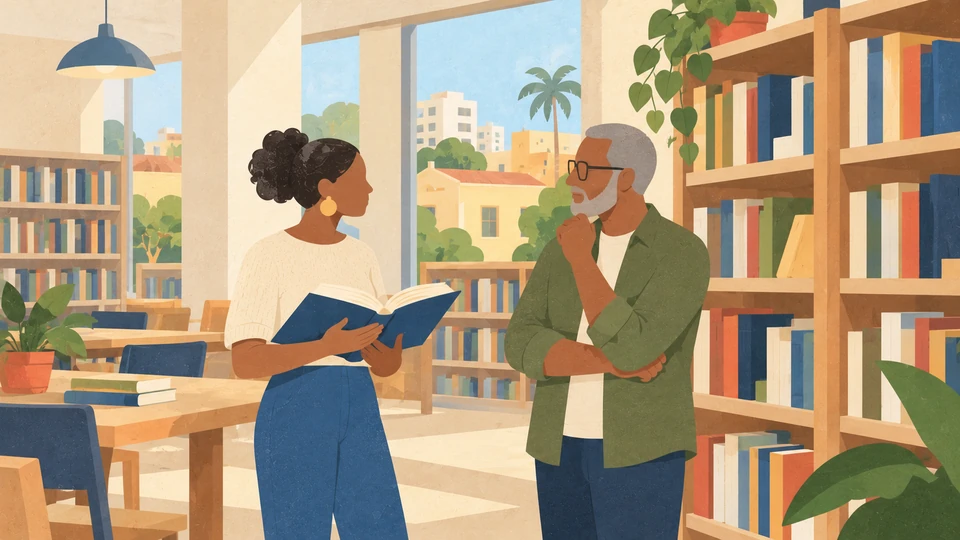
In Maputo, the Camões cultural centre describes a library with a particular emphasis on literatures in Portuguese. Its library and gallery also accommodate conversations, debates, film screenings and book launches. The centre describes collaboration with Mozambican institutions and exchanges between Mozambican and Portuguese artists and writers.
This gives a concrete cultural setting for the language’s international life. A common language can enable people to read one another’s work while their histories, subjects and perspectives remain different. The resulting conversation has many contributors, and understanding Portuguese means attending to where those voices come from.
Sources
- Museu da Língua Portuguesa. Português do Brasil (2021-08-30). https://www.museudalinguaportuguesa.org.br/portuguesdobrasil/
- Ataliba Castilho (catalogued speaker/author); Museu da Língua Portuguesa (catalogue description). Os primórdios da língua portuguesa. https://acervo.museudalinguaportuguesa.org.br/acervos/museologico/2355/os-primordios-da-lingua-portuguesa
- J. Clancy Clements; in The Cambridge Handbook of Language Contact, Volume 1, edited by Salikoko S. Mufwene and Anna María Escobar. The Expansion and Evolution of Portuguese. https://www.cambridge.org/core/books/abs/cambridge-handbook-of-language-contact/expansion-and-evolution-of-portuguese/B60707015A6D98809FE28A88395BF85B
- Augusto Soares da Silva; Universidade Católica Portuguesa; Energeia IX, pp.18–56. Que estandardização para o português: pluricêntrica ou panlusófona? (2024-10-31). https://energeia-online.org/article/view/8659/7344
- Instituto Internacional da Língua Portuguesa; Academia das Ciências de Lisboa / Instituto de Lexicologia e Lexicografia da Língua Portuguesa. Atlas Lexicográfico da Língua Portuguesa (ALLP). https://projetosilllp.acad-ciencias.pt/index.php/allp
- Instituto Internacional da Língua Portuguesa / Comunidade dos Países de Língua Portuguesa. Vocabulário Ortográfico Comum da Língua Portuguesa — Página Inicial. https://voc.iilp.cplp.org/index.php?action=von&von=all
- Camões – Centro Cultural Português em Maputo; Camões, I.P. network in Mozambique. Quem somos. https://camoes-ccpmocambique.co.mz/quem-somos/
- Cátedra de Português Língua Segunda e Estrangeira, Universidade Eduardo Mondlane. Bases de Dados. https://www.catedraportugues.uem.mz//base-de-dados