Languages & Culture
Quechua
Quechua is a shared name for a diverse Indigenous language family, used across several South American countries, including Peru, Ecuador, Bolivia, Colombia and Argentina. Peru’s Ministry of Culture explicitly describes this family scope, even though official documents also use the singular language as an administrative umbrella. A broad label therefore needs a local explanation: where a variety is spoken, what speakers call it and which conventions a teaching resource follows.
A family with regional histories
A widely used classification distinguishes Quechua I, concentrated in central Peru, from Quechua II, with varieties farther north and south. Linguist Willem Adelaar explains the evidence for this division while acknowledging scholarly challenges to it. Language-family diagrams are arguments about historical relationships, not perfectly bounded maps of present communities. Vocabulary can travel across neighbouring varieties, making individual shared words an unreliable guide to ancestry.
Peru’s official database also organises varieties into Amazonian, northern, central and southern groups for its regional overview. It lists Chanka in Ayacucho and neighbouring areas, Collao in Cusco, Puno and elsewhere, and Kichwa among Amazonian varieties. These labels locate particular communities; Kichwa should not simply replace Quechua as a name for the entire family. Nothing in a broad catalogue label establishes how easily speakers of two unspecified varieties will understand one another.
A history longer than the Inca state
Quechua’s association with the Incas is important, but does not mark the family’s beginning. Peru’s official account describes expansion before the Inca empire and later use for communication across populations with different languages. Its discussion of an earlier central-Andean origin remains a historical reconstruction, rather than a securely identified birthplace.
Expansion also continued under Spanish colonial rule. César Itier’s research identifies cities, mines and estates within the colonial economy as settings for further spread and everyday adoption. Conquest did not produce a simple, immediate replacement of Quechua by Spanish; changing institutions and movements of people reshaped where particular varieties were used.
Contact with Aymaran languages reaches further back. Adelaar treats the two as separate families whose substantial similarities reflect prolonged interaction; he explains that a common genealogical origin has not been convincingly demonstrated. Shared features therefore require historical interpretation, not an assumption that Quechua and Aymara are the same language.
Documentation starts with a place and its speakers
Teaching projects can make variation explicit. In their 2025 account of the Quechua Innovation and Teaching Initiative, its authors describe recorded dialogues for the open educational textbook Ayni that bring together Ayacucho, Cochabamba and Cuzco-Collao varieties. Their description identifies mutual comprehension as a design consideration within that selected grouping; it does not promise one course for every Quechuan variety.
Children become broadcasters
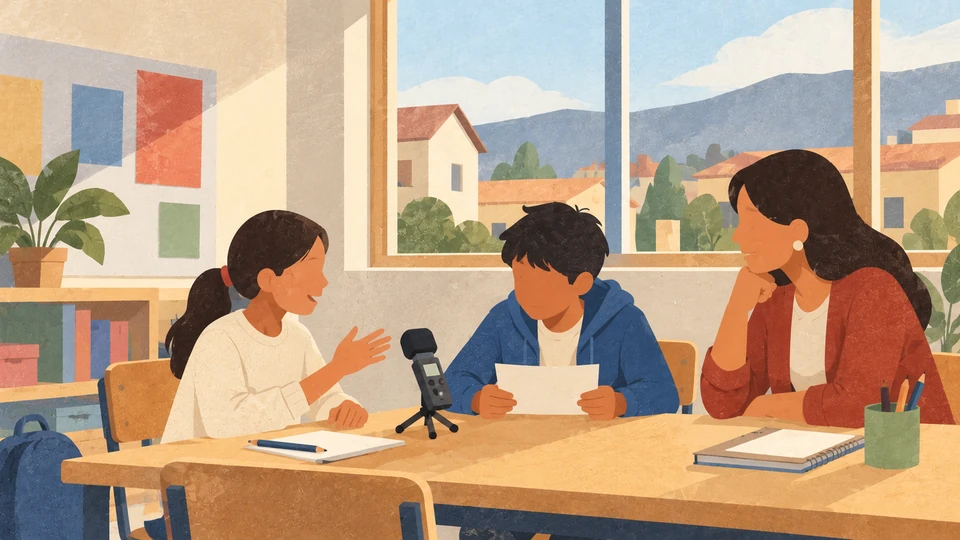
The Cusco educational association Pukllasunchis offers another practical setting. Its radio programme connects pupils, teachers and families in producing material about community knowledge and experience. Programmes reach rural and urban schools, and broadcasts become resources for further classroom work. Children help create the material, rather than only receiving lessons made elsewhere.
Quechua community life also extends beyond South America. The New York Quechua Initiative’s own account records its founding in 2012 and a mission of workshops, cultural events and education. Such community work, alongside teaching projects and school radio, shows why Quechua belongs in discussions of present-day creativity as well as Andean history.
Sources
- Ministerio de Cultura del Perú; Base de Datos Oficial de Pueblos Indígenas u Originarios. Quechua. https://bdpi.cultura.gob.pe/index.php/lenguas/quechua
- Willem Adelaar; Leiden University Centre for Linguistics. Trayectoria histórica de la familia lingüística quechua y sus relaciones con la familia lingüística aimara. https://revistas.pucp.edu.pe/index.php/boletindearqueologia/article/download/1334/1288
- César Itier; in The Cambridge Handbook of Language Contact, edited by Salikoko Mufwene and Anna Maria Escobar. Quechua Expansion during the Inca and Colonial Periods. https://www.cambridge.org/core/books/abs/cambridge-handbook-of-language-contact/quechua-expansion-during-the-inca-and-colonial-periods/996B6E404CEAC14EE68BFE9B30E19B54
- Carlos Molina-Vital, Marilyn Manley, Alana DeLoge and Américo Mendoza-Mori; in The Cambridge Handbook of Multilingual Education, edited by Piotr Romanowski. Quechua Innovation and Teaching Initiative (QINTI): Contributing to the Landscape of Quechua L2 Instruction. https://www.cambridge.org/core/books/abs/cambridge-handbook-of-multilingual-education/quechua-innovation-and-teaching-initiative-qinti/FA8CD1CCB8906CAB223B6E470A2ACAE6
- Asociación Pukllasunchis. Radio Pukllasunchis: Programa Radial. https://www.pukllasunchis.org/radio/radio.html
- The New York Quechua Initiative. About / Contact. https://nyquechua.wordpress.com/about-contact/