Languages & Culture
Romanian
Romanian is a Romance language whose history combines Latin inheritance with centuries of contact in southeastern Europe. It is used in Romania and the Republic of Moldova, in neighbouring countries and in diaspora communities. This geography includes different local experiences and ways of speaking; a national border does not mark the edge of everyone’s linguistic world.
Its vocabulary records those connections. Inalco’s language profile identifies contributions from Slavic languages, Hungarian, Turkish and Greek, followed by substantial French influence in the nineteenth century. Borrowing does not cancel Romanian’s Romance affiliation. It helps explain how a language inherited through generations also acquires words through changing cultural, commercial and intellectual relationships.
Romanian and the name Moldovan
Moldovan is a historically and politically significant name used for the same language, rather than evidence of a separate Latin-derived lineage. That linguistic relationship should be kept distinct from an individual’s preferred national or cultural identity. Regional speech differences and personal attachments do not disappear when official terminology changes.
In March 2023, Moldova’s parliament adopted legislation replacing Moldovan with Romanian in relevant legislative wording, and the presidency announced its promulgation on 22 March. The Constitutional Court’s subsequent 2024 judgment describes the change and reproduces Article 13 naming Romanian as the state language. This is a documented development in legal terminology, not a claim that people began speaking a new language that month.
A letter written because news mattered
An important early surviving Romanian document is Neacșu’s letter of 1521, sent from Câmpulung to Johannes Benkner in Brașov. Romania’s cultural-heritage portal presents its text and historical setting: the writer was conveying urgent information about Ottoman military movements south of the Danube. His message belonged to practical communication between people concerned about what might happen next.
The letter also shows languages meeting within one document. Slavonic opening and closing formulas frame a Romanian message, with further Slavonic wording inside it. The portal’s commentary identifies grammatical and lexical features characteristic of the period. A surviving letter is therefore evidence of an established communicative practice, not a birth certificate for the spoken language. Its historical forms should be read in context rather than offered as everyday phrases for a modern beginner.
Different tools answer different questions
Modern Romanian scholarship includes both recommendations for standard usage and evidence of how language occurs in texts. The Institute of Linguistics’ DOOM³ dictionary, based on its 2021 print edition, addresses spelling, pronunciation and grammatical word forms. Its introductory explanation also discusses labels for older, regional and familiar usage. These labels help readers recognise a word’s register without making every entry suitable for every situation.
DOOM³ is primarily a dictionary of forms; its own description directs readers elsewhere for definitions. The question determines the resource: checking a standard inflection is different from establishing a word’s meaning or investigating its use in a particular setting.
The CoRoLa research project supplies another kind of evidence. A 2018 paper by its developers describes written texts and transcribed recordings, with information about sources and grammatical annotation. The authors explain that legal writing predominated in the written collection they reported. This matters when interpreting frequency: a common word in that collection may partly reflect the material selected, rather than every Romanian speaker’s everyday conversation.
A spring practice shared across borders
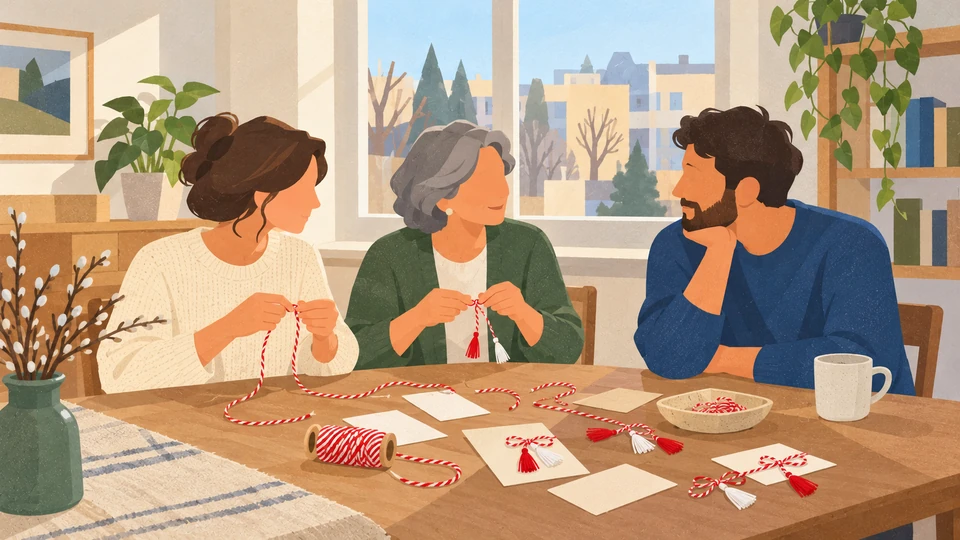
One cultural setting for conversation and intergenerational learning is the making of mărțișoare, small spring tokens associated with red-and-white threads. A heritage account from UNESCO’s regional centre in Sofia places the related practices in Romania, Moldova, Bulgaria and North Macedonia. Making, offering and wearing the threads are shared regional practices, with local forms and names. They are not exclusive markers of one language or citizenship.
The National Museum of Ethnography and Natural History in Chișinău documented a workshop on 28 February 2025 where children and young people learned making techniques and discussed the colours and March customs. Participants used threads, silk and plant fibres to create gifts for people close to them. This particular event connects explanation, practical skill and social relationships: cultural knowledge is shared through doing something together, while each participant makes an object of their own.
Sources
- Center for Language Technology, Indiana University. Romanian. https://celt.indiana.edu/portal/Romanian/index.html
- Institut national des langues et civilisations orientales (Inalco). Roumain. https://www.inalco.fr/langues/roumain
- Președinția Republicii Moldova. Președinta Maia Sandu a promulgat Legea care confirmă că limba de stat a Republicii Moldova este cea română (2023-03-22). https://presedinte.md/rom/presa/presedinta-maia-sandu-a-promulgat-legea-care-confirma-ca-limba-de-stat-a-republicii-moldova-este-cea-romana
- Institutul de Lingvistică Iorgu Iordan – Alexandru Rosetti. Dicționarul ortografic, ortoepic și morfologic al limbii române (DOOM³) — Despre dicționar. https://doom.lingv.ro/
- Verginica Barbu Mititelu, Dan Tufiș and Elena Irimia; Romanian Academy Research Institute for Artificial Intelligence. The Reference Corpus of the Contemporary Romanian Language (CoRoLa). https://aclanthology.org/L18-1189.pdf
- Regional Centre for the Safeguarding of Intangible Cultural Heritage in South-Eastern Europe under the auspices of UNESCO, Sofia. Happy “Grandma March Day”!. https://www.unesco-centerbg.org/en/2018/03/01/happy-grandma-march-day/
- Muzeul Național de Etnografie și Istorie Naturală, Chișinău; displayed byline muzeu. Atelierul „Tradiție și creativitate în fiecare fir” (2025-02-28). https://www.muzeu.md/atelierul-traditie-si-creativitate-in-fiecare-fir/
- Curtea Constituțională a Republicii Moldova. Hotărârea nr. 8 din 11 martie 2024 privind controlul constituționalității Legii nr. 52 din 16 martie 2023 pentru implementarea considerentelor unor hotărâri ale Curții Constituționale (sesizarea nr. 94a/2023) (2024-03-11). https://constcourt.md/public/ccdoc/hotariri/h_8_2024_94a_2023_rou.pdf
- CIMEC; collection index credits collaboration with students of the Faculty of History, University of Bucharest. Scrisoarea lui Neacsu din Campulung. https://www.cimec.ro/istorie/neacsu/rom/default.htm
- CIMEC; transcription attributes its text to Hurmuzachi–Iorga, Documente, XI, 843. Textul scrisorii. https://www.cimec.ro/istorie/neacsu/rom/scrisoare.htm
- Ion Rotaru, excerpt from Literatura română veche (București, 1981), pp. 62–65, presented by CIMEC. Limba română în vremea lui Neacşu. https://www.cimec.ro/istorie/neacsu/rom/limbarom.htm
- Viorela-Valentina Dima; Studii şi comunicări / DIS, vol. XIV; CRIFST, Romanian Academy. Scrisoarea lui Neacșu din Câmpulung: 500 de ani de atestare documentară a limbii române (2021). https://studii.crifst.ro/doc/2021/2021_01_03.pdf