Languages & Culture
Samoan
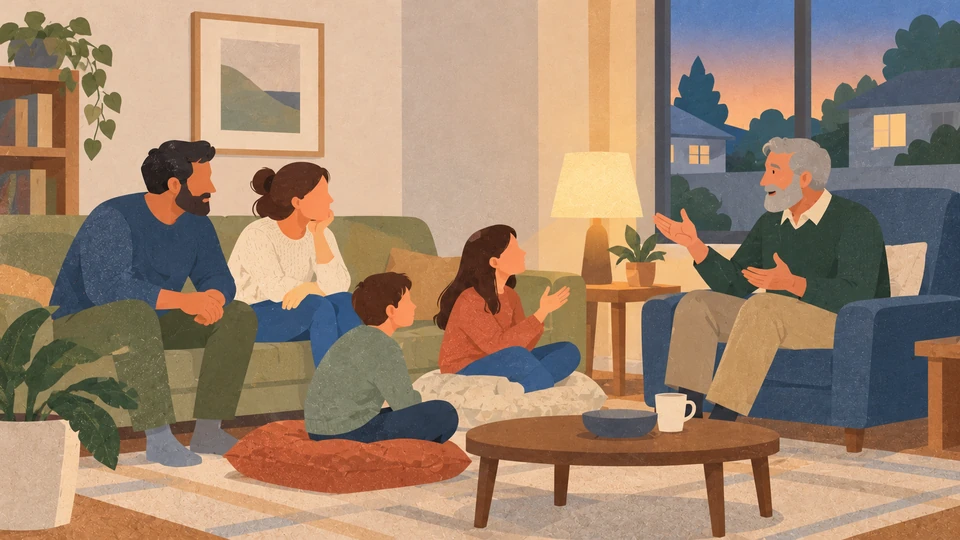
Samoan, or gagana Sāmoa, is a Polynesian language within the Austronesian family. Its island home includes Samoa and American Samoa. The catalogue label names a language, while differences in speaking style and writing practice require attention within it.
Writing and speaking have different histories
Nineteenth-century printing helped establish an enduring written tradition. New Zealand’s Ministry for Pacific Peoples records the publication of the complete Samoan Bible and George Pratt’s grammar and dictionary in 1862. The ministry’s historical timeline also identifies G. B. Milner’s 1966 dictionary, commissioned by the governments of Western Samoa and American Samoa. These works belong to different periods of documentation; they are not interchangeable descriptions of every contemporary speaker.
Spelling guidance has a context. The ministry’s 2024 orthography guidelines explicitly address writing and learning in New Zealand. They recommend marking every long vowel with a macron, while acknowledging that other authorities favour more selective marking. Readers should therefore check a resource’s conventions before treating an unfamiliar spelling as an error. The guide supports consistency for its intended users without establishing that all Samoan communities write identically.
Speaking styles introduce another distinction. In his 2020 account for Te Papa, Samoan scholar Sadat Muaiava discusses t-style and k-style, conventionally associated with formal and informal speech. These are registers of Samoan, with social meanings and differences in consonant pronunciation. Muaiava also reports hearing both styles in church and customary contexts. His observation cautions against learning a rigid rule that assigns one style to every religious occasion and the other to every cultural gathering. Choosing language appropriately involves relationships and setting as well as the forms printed in a textbook.
What researchers can learn from words
Samoan also contributes to detailed research on how languages organise sound. John Alderete and Mark Bradshaw’s 2013 study examined which sounds and sound combinations occur in word roots, using a dataset assembled from Milner’s dictionary. They documented patterns of relative frequency rather than simply listing an alphabet. Their analysis focused on the literary register and deliberately excluded loanwords and certain complex forms. Those decisions matter: a carefully defined research sample can reveal structure without representing every word or every conversation.
Language scholarship is also part of Samoa’s own institutional history. Eric Clem Groves and Matiu Matavai Tautunu’s 2021 study traces the National University of Samoa’s development from its foundation in 1984. Drawing on university records and interviews, they describe the growth of Samoan studies and the work of Fanaafi Le Tagaloa in developing its teaching. Their account records conferences producing work in English and Samoan and a university-wide history-and-society course introduced in 2018 and taught in both languages. Samoan here functions as a medium for examining history and society as well as a subject of study.
Education across connected communities
In American Samoa, the community college’s Samoan Studies Institute describes a programme combining teaching, fieldwork, archival research and cultural extension. Translation and interpretation between Samoan and English are part of its work with government agencies and communities, with students encouraged to participate. This connects language study with practical public communication and professional experience.
In Hawaiʻi, the University of Hawaiʻi at Mānoa’s Samoan programme dates its work to 1977. Its public description includes conversation, literature, linguistics and ceremonial speech, alongside a community language school serving preschool children through adults. The range shows why learning opportunities need to accommodate different ages and purposes, from everyday interaction to more specialised cultural knowledge.
Stories can travel in more than one language
The Digital Fāgogo Collective offers a distinctive example of diaspora cultural work. Its Samoan tales and histories are retold in English, and the project explicitly declines to present one version as authoritative. Family variations are welcomed as contributions to a broader understanding of the stories. It is therefore a resource for cultural connection whose language medium should be understood clearly.
The organisers describe how nightly Facebook storytelling during the Covid-19 pandemic developed into the volunteer collective. Its contributors include people based in Utah, and its account stresses stories passed through families and shared across distance. That approach leaves room for several tellers and inherited versions. It also makes a useful distinction for learners: engaging with Samoan cultural narratives in English can accompany language learning, while gaining experience in Samoan itself requires resources and interaction in Samoan.
Sources
- Ministry for Pacific Peoples, New Zealand. Gagana Sāmoa — Orthography Guidelines (2024). https://www.mpia.govt.nz/assets/Resources/Orthography-guidelines/gagana-samoa-orthography-guidelines.pdf
- John Alderete and Mark Bradshaw. Samoan Root Phonotactics: Digging Deeper into the Data. https://journals.dartmouth.edu/journals/xmlpage/1/article/424?htmlOnce=yes
- Le’ausālilō Lupematasila Fata ‘Au’afa Dr Sadat Muaiava; Museum of New Zealand Te Papa Tongarewa. ‘Good talk’ and ‘bad talk’: T-style and K-style in gagana Sāmoa (2020-05-26). https://blog.tepapa.govt.nz/2020/05/26/good-talk-and-bad-talk-t-style-and-k-style-in-gagana-samoa/
- University of Hawaiʻi at Mānoa, Department of Indo-Pacific Languages & Literatures. Samoan Program. https://manoa.hawaii.edu/ipll/language-programs/samoan/index.php
- American Samoa Community College. Samoan Studies Institute. https://www.amsamoa.edu/Departments_Offices/Divisions/ssi.html
- Eric Clem Groves and Matiu Matavai Tautunu. Higher Education and the Indigenous Language and Culture: Samoanisation of the National University of Samoa. https://www.usp.ac.fj/journal-of-pacific-studies/wp-content/uploads/sites/162/2023/05/Higher-Education-and-the-Indigenous-Language-and-Culture-Samoanisation-of-the-National-University-of-Samoa.pdf
- The Digital Fāgogo Collective. The Digital Fāgogo Collective. https://www.fagogo.org/
- The Digital Fāgogo Collective; Jacob Fitisemanu and Laneta Fitisemanu-Taukei’aho identified as contributors/curators. About — The Digital Fāgogo Collective. https://www.fagogo.org/about
- WALS Online; edited by Matthew S. Dryer and Martin Haspelmath. Language Samoan. https://wals.info/languoid/lect/wals_code_sam