Language & culture
Scottish Gaelic: A Language of Scotland and Nova Scotia
Language at a glance
- Speakers
- 69,701 · Scotland
2022 census; age 3+; reported speaking ability.
- Local name
- Gàidhlig
The language’s own Gaelic name.
- Communities
- Scotland · Nova Scotia
Western Isles, Highlands and Cape Breton.
- Language family
- Celtic · Goidelic
Related to Irish and Manx.
- Writing
- 18 Latin letters
Modern Scottish Gaelic spelling with accented vowels.
- Regional varieties
- Island and Nova Scotian
Lewis, Harris, Uist, Skye and Barra.
Who speaks Scottish Gaelic, and what do they call it?
Speakers call the language Gàidhlig. Its communities include the Western Isles, Highlands and Argyll and Bute, alongside Nova Scotia’s Cape Breton Island and northeastern mainland, where families have maintained Gaelic across generations.
How many people speak Scottish Gaelic in Scotland?
Scotland’s 2022 census recorded 69,701 people aged three and over with reported ability to speak Gaelic. A comparable worldwide total remains uncertain.
Where did Scottish Gaelic come from, and who spoke it in the past?
Scottish Gaelic, Irish and Manx form the Goidelic branch of Celtic. Gaelic was established among Argyll’s rulers and churchmen by the sixth century; its earlier arrival is debated. It later spread across much of mainland Scotland.
The twelfth-century Book of Deer notes are the earliest surviving continuous Gaelic text written in Scotland. Land grants were recorded in an older Latin book’s margins, centuries after Gaelic was spoken.
Which Scottish Gaelic words might an English speaker already recognise?
- Slogan has Gaelic ancestry: historic Scots forms come from sluagh-ghairm, a rallying or battle cry.
- Glen, a valley, reached English through Scots from gleann, shared by Scottish Gaelic and Irish and traceable to Old Irish.
How does Scottish Gaelic vary from region to region?
Pronunciation and vocabulary vary across Lewis, Harris, Uist, Skye and Barra, sometimes within one island. Lewis uses bùrn for water alongside uisge. Nova Scotia Gaelic carries several Scottish dialect traditions.
What is standard written Scottish Gaelic, and where is it used?
Gaelic Orthographic Conventions (2009) guides spelling in education, media and public administration in Scotland. It usually recommends one spelling, while allowing some alternatives. These written conventions do not require one spoken accent.
Which alphabet does Scottish Gaelic use, and what might surprise an English speaker?
Modern Scottish Gaelic spelling has 18 Latin letters: a, b, c, d, e, f, g, h, i, l, m, n, o, p, r, s, t and u. Borrowings sometimes use other letters. Grave accents normally mark longer vowels: à, è, ì, ò and ù are vowel forms, not extra letters. bata means stick; bàta means boat. Older acute-accent spelling remains in use in Canada.
Does Scottish Gaelic have grammatical gender?
Yes: nouns, including words for things, are masculine or feminine.
How do you say hello, thank you and goodbye in Scottish Gaelic?
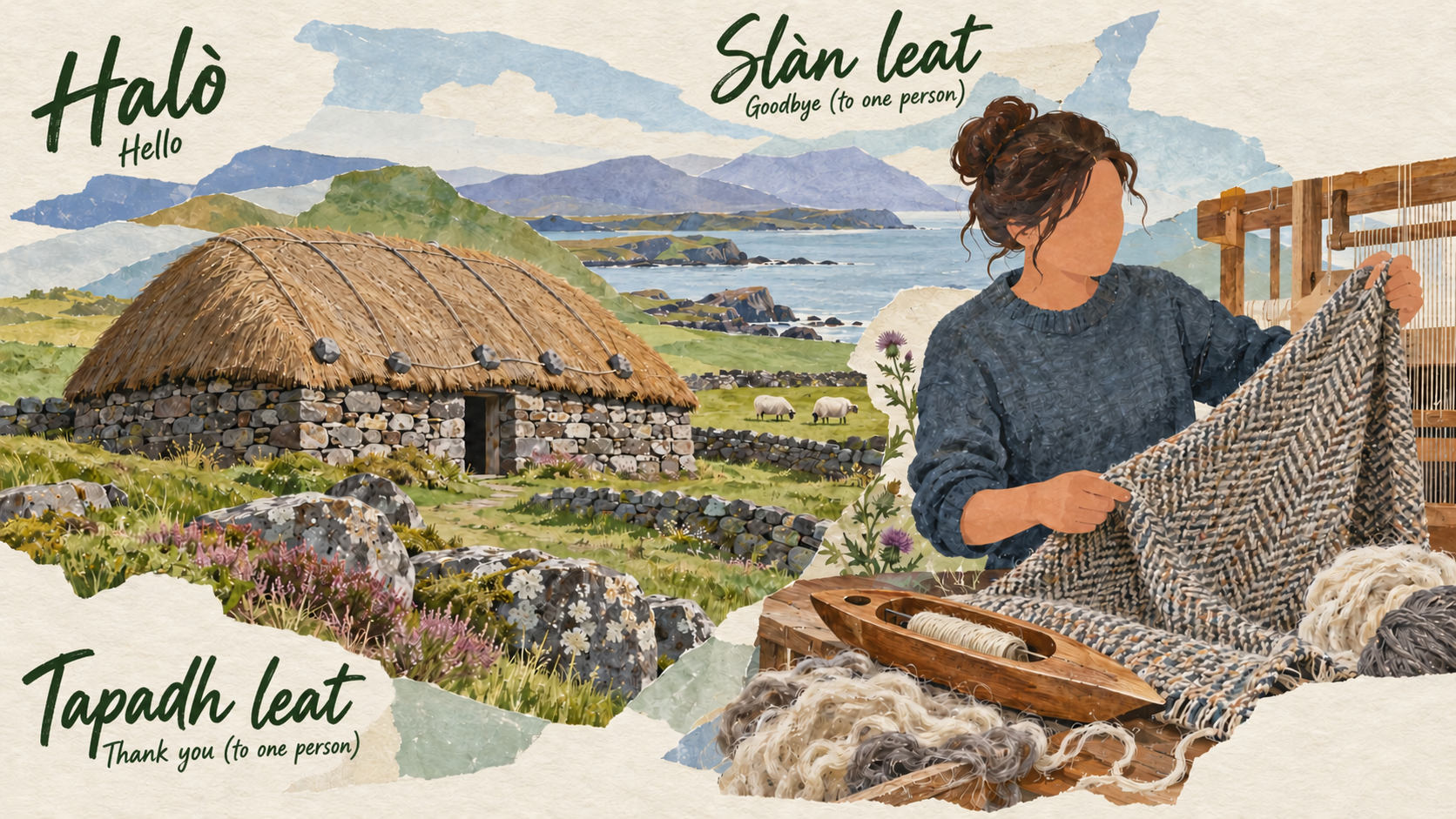
- Halò — hello.
- Tapadh leat — thank you, as said to a friend or child.
- Slàn leat — goodbye.
What are some memorable Scottish Gaelic sayings?
- Tuig thus’ an t-eathar, ’s tuigidh an t-eathar thu. — “Understand the boat and the boat will understand you.” It values knowing what one works with; Roddy Maclean recalled it displayed in Tobermory’s Mishnish Hotel.
- Is fheàrr a bhith a dhìth a’ chinn na a dhìth an fhasain. — losing one’s head is preferable to losing one’s style. This comic saying appears in SpeakGaelic’s clothes-shopping lesson.
What everyday customs might surprise a visitor?
A cèilidh can mean a visit as well as a social gathering. At Cultarlann Inbhir Nis in Inverness, cèilidh nights bring together Gaelic, songs, live music and group dances. A caller helps dancers, and people can also watch and socialise.
Which Scottish Gaelic-language song and film offer a cultural introduction?
Fear a’ bhàta, sung in Gaelic by Sineag MacIntyre on LearnGaelic, voices longing for a fisherman. It is traditionally associated with Sìne NicFhionnlaigh of Tong, Lewis, although accounts of its origins differ. Gaelic words and English translations accompany the performance.
Seachd: The Inaccessible Pinnacle (2007), directed by Simon Miller, follows Aonghas on Skye through family grief and his grandfather’s tales of water-horses and Spanish gold. It includes Gaelic, English, Spanish and some Scots; subtitled versions exist.
What is available for someone curious about the language now?
- LearnGaelic offers a free searchable dictionary with sound clips, plus transcribed and translated video and audio.
- SpeakGaelic has free A1–B2 online lessons, television programmes and podcasts, with a Sabhal Mòr Ostaig curriculum.
- Tobar an Dualchais / Kist o Riches has Gaelic, Scots and English recordings from the 1930s onward. They include Angus MacLellan’s 1949 recitation of Duan na Ceardaich, recorded by John Lorne Campbell. In it, Fionn MacCumhail and his companions take a magical sword to an enchanted smithy.
- The Scottish Poetry Library places Sorley MacLean’s Hallaig beside his own English translation. Its landscape fills with absent generations, and women become birch trees.
Fun Facts
- Edinburgh’s Craigentinny comes from creag an t-sionnaich, meaning fox craig.
- In direct address, Màiri becomes a Mhàiri and Seumas becomes a Sheumais. These forms help explain the English names Mhairi and Hamish.
Sources
- Thomas Owen Clancy; Bòrd na Gàidhlig. Gaelic Scotland: a brief history. 2005.
https://www.gaidhlig.scot/wp-content/uploads/2016/12/Clancy-2005-Eachdraidh-na-G%C3%A0idhlig-CR05-01-x2-History-of-Gaelic.pdf - Scottish Government. Scottish Islands Data Overview (2025), 14 Arts, Culture and Language. 2025-09-09.
https://www.gov.scot/publications/scottish-islands-data-overview-2025/pages/16/ - National Records of Scotland. Scotland’s Census – religion, ethnic group, language and national identity results. 2024-05-21.
https://www.scotlandscensus.gov.uk/news-and-events/scotland-s-census-religion-ethnic-group-language-and-national-identity-results/ - Nova Scotia Archives. Gaelic Resources | Goireasan Gàidhlig: Introduction. n.d.
https://archives.novascotia.ca/gaelic/introduction/ - LearnGaelic. Speaking Our Language: I’m well, thank you (plural / polite). n.d.
https://learngaelic.scot/sol/episodes/ep.jsp?clip=3&prog=1 - Roddy Maclean; LearnGaelic. An Litir Bheag 839: Cheerio. n.d.
https://www.learngaelic.scot/litirbheag/litir.jsp?l=839 - LearnGaelic. Speaking Our Language: I’m going to work/to visit. n.d.
https://learngaelic.scot/sol/episodes/ep.jsp?clip=6&prog=11 - Cultarlann Inbhir Nis. Cèilidh programme. n.d.
https://cultarlann.scot/ceilidh-programme/ - Sorley MacLean; Scottish Poetry Library. Hallaig, with the author’s English translation. undated webpage; cited collected edition 2011.
https://www.scottishpoetrylibrary.org.uk/poem/hallaig/ - Scottish Poetry Library. Somhairle MacGill-Eain / Sorley MacLean. 2012 (date shown on the English biography).
https://www.scottishpoetrylibrary.org.uk/poet/sorley-maclean/ - Sabhal Mòr Ostaig. Tobar an Dualchais – Kist o Riches. n.d.
https://www.smo.uhi.ac.uk/tobar-an-dualchais-kist-o-riches/?lang=en - LearnGaelic. The Scottish Gaelic Alphabet. n.d.
https://learngaelic.scot/scottish-gaelic-alphabet.jsp - Dictionaries of the Scots Language; A Dictionary of the Older Scottish Tongue. Slog(g)orn(e, Slughorn(e, Slogan(e. 2001 (DOST Vol. IX).
https://dsl.ac.uk/entry/dost/sloggorne - Scottish Qualifications Authority. Gaelic Orthographic Conventions. October 2009; publication BB4616.
https://www.sqa.org.uk/files_ccc/SQA-Gaelic_Orthographic_Conventions-En-e.pdf - Dàta airson Stòras na Gàidhlig (DASG). The Gaelic Notes in the Book of Deer [corpus metadata]. Undated webpage; describes the 1972 edition by Kenneth Jackson, Cambridge University Press.
https://dasg.ac.uk/corpus/textmeta.php?text=195&uT=y - Merriam-Webster. Glen. Undated entry; page shows last update 26 September 2026.
https://www.merriam-webster.com/dictionary/glen - Wilson McLeod. Dialectal diversity in contemporary Gaelic: perceptions, discourses and responses. 2017; pp. 183–211.
https://www.abdn.ac.uk/sll/documents/McLeod-Dialectal-Diversity.pdf - LearnGaelic. Scottish Gaelic vocabulary: drinks. n.d.
https://learngaelic.scot/fichead-facal/ff-gaelic-names-drinks.jsp - LearnGaelic. Language morsels / Criomagan Cànain. n.d.
https://learngaelic.scot/grammar/criomagan-canain.jsp - Roddy Maclean. An Litir Bheag 221: Understand the boat. n.d.
https://learngaelic.scot/litirbheag/litir.jsp?l=221 - Sgoil Gàidhlig Bhaile an Taigh Mhòir. Tuig thus’ an t-eathar, ’s tuigidh an t-eathar thu. n.d.
https://sgoilgaidhlig.org/news/gnathasan-cainnte-agus-seanfhacail-phrases-and-old-sayings/tuig-thus-an-t-eathar-s-tuigidh-an-t-eathar-thu/ - SpeakGaelic. Buying clothes / A’ ceannach aodach. n.d.
https://speakgaelic.scot/level/fasan/topic/a-ceannach-aodach - LearnGaelic; performance by Sineag MacIntyre. Learn a Gaelic song – Fear a’ bhàta. n.d.
https://learngaelic.scot/littlebylittle/songs/bata/index.jsp - British Council UK Films Database. Seachd: The Inaccessible Pinnacle. Updated 12 May 2025; film year 2007.
https://filmsandfestivals.britishcouncil.org/projects/seachd-the-inaccessible-pinnacle - Young Films / Seachd official website. Seachd: The Inaccessible Pinnacle — Cast & Crew. n.d.
https://www.seachd.com/cast-crew - James Macgregor, interviewer; Simon Miller, interviewee. SHOOTING PEOPLE: Interview with Simon Miller. 16 September 2007 (official-site republication).
https://www.seachd.com/blog/2007/09/16/shooting-people - Andrew Robertson. EYE FOR FILM: Review — “an astonishing production”. 16 September 2007 (official-site republication).
https://www.seachd.com/blog/2007/09/16/eye-for-film-re - LearnGaelic. LearnGaelic: free online Scottish Gaelic learning resources. n.d.
https://learngaelic.scot/ - LearnGaelic. Dictionary / Faclair. n.d.
https://learngaelic.scot/dictionary/ - MG ALBA / SpeakGaelic. SpeakGaelic. n.d.
https://speakgaelic.scot/ - SpeakGaelic. Learn online. n.d.
https://speakgaelic.scot/all-online-courses
Start learning today
Explore these books to keep learning.