Languages & Culture
Scottish Gaelic
Scottish Gaelic belongs to the Goidelic branch of the Celtic languages, alongside Irish and Manx. These related languages have distinct histories; Scottish Gaelic is also different from Scots, whose history leads back to Old English. The word Gàidhlig names a language with regional voices, historical records and present-day speakers and learners.
A wider geography than the familiar image
Gaelic’s history cannot be contained within a picture of the Highlands. Historian Thomas Owen Clancy describes its medieval reach across much of mainland Scotland and the place-names left in areas where community speech later receded. He also explains that Gaelic was established in Argyll by the sixth century, while acknowledging debate about the processes connecting early Gaelic in Ireland and western Scotland. A simple account of one migration on one date would conceal that uncertainty.
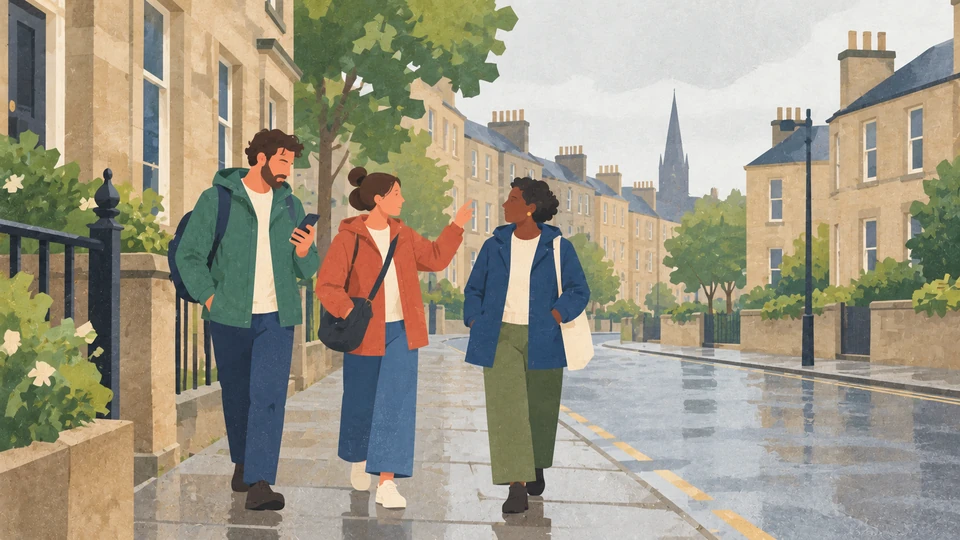
Glasgow offers a particularly useful urban perspective. University research has examined the city’s Gaelic place-names, students and cultural connections. Its public account describes work with Glasgow City Council that helped create the bilingual Glaschu website, exhibitions and song trails. These are concrete ways of making the city’s Gaelic history visible. They also challenge the assumption that an urban setting must lie outside Gaelic cultural life.
The Glaschu project’s self-led QR-code trail connects places with further information on the website and finishes at Glasgow Cathedral. Following the trail is one way to consider language through the city’s streets and buildings, rather than through vocabulary alone. The project presents Gaelic as part of Glasgow’s past and present; its existence is evidence of public cultural work, not a measurement of how often everyone in the city speaks Gaelic.
Listening to the archive, building the dictionary
A recording preserves more than a written word list. Tobar an Dualchais, also named Kist o Riches, makes oral recordings from Scotland and its diaspora available online. Sabhal Mòr Ostaig’s description identifies songs, stories, poetry, music and historical recollections recorded from the 1930s onwards. The material includes Gaelic, Scots and English, with varied dialects and accents. Its principal collections come from the School of Scottish Studies, the National Trust for Scotland’s Canna Collection and BBC Radio nan Gàidheal. Checking a recording’s language and provenance is therefore part of using the archive responsibly.
Those voices can also inform scholarship. In May 2021, Sabhal Mòr Ostaig reported the completed second phase of collaboration between the archive and Faclair na Gàidhlig, the dictionary project. Archive staff transcribed selected recordings; dictionary researchers assessed what the material could contribute, and oral evidence was added to the project’s corpus. This gives a clear example of the work between collecting a recording and using it as lexical evidence. The report documents a completed phase of collaboration, without establishing that the entire dictionary was finished.
Creating opportunities to use Gaelic
Present-day language development involves people with different relationships to Gaelic. UHI North, West and Hebrides’ published strategy for 2024–2029 includes supporting adults returning to a language they already know to some degree. Its 2025–2030 language plan also identifies community partnerships, immersive experiences and links with employment as priorities. These are stated commitments, whose results require separate evaluation. They show why language support must consider opportunities to use existing knowledge as well as opportunities to begin learning.
The Atlantic is part of this story too. Nova Scotia Archives describes migration from the Highlands and Islands and the development of Gaelic-speaking communities in northeastern mainland Nova Scotia and Cape Breton. Its account also discusses the damage caused by schooling that privileged English and stigmatised Gaelic. Alongside that history, it records community learning approaches built around activities, household language, gesture and immersion. Nova Scotian Gaelic has its own inherited community experience, rather than being merely an overseas classroom subject.
One example is the Gaelic College’s Na Gaisgich Òga youth mentorship programme, launched in 2013. Its description brings together immersion, local Gaelic-speaking mentors, elders and learning through song, storytelling and community activities. The advertised 2026–2027 programme combines college weekends with mentorship in participants’ communities. That is a programme design, not a guarantee of fluency. It nevertheless shows a practical principle running through this work: learners need people and shared activities through which Gaelic can become part of ordinary life.
Sources
- Thomas Owen Clancy, University of Glasgow; hosted by Bòrd na Gàidhlig. Gaelic Scotland: a brief history. https://www.gaidhlig.scot/wp-content/uploads/2016/12/Clancy-2005-Eachdraidh-na-G%C3%A0idhlig-CR05-01-x2-History-of-Gaelic.pdf
- Sabhal Mòr Ostaig. Tobar an Dualchais – Kist o Riches. https://www.smo.uhi.ac.uk/tobar-an-dualchais-kist-o-riches/?lang=en
- Sabhal Mòr Ostaig. Gaelic collaborative project reaches new milestone (2021-05-08). https://www.smo.uhi.ac.uk/gaelic-collaborative-project-reaches-new-milestone/?lang=en
- UHI North, West and Hebrides. Gaelic. https://www.nwh.uhi.ac.uk/en/about-us/gaelic/
- Nova Scotia Archives. Gaelic Resources | Goireasan Gàidhlig. https://archives.novascotia.ca/gaelic/introduction/
- Glaschu project. Welcome to our QR Code Trail – Fàilte don t-Slighe Còd QR againn. https://glaschu.net/welcome-to-our-qr-code-trail/
- University of Glasgow. Transforming Glasgow’s relationship with the Gaelic language. https://www.gla.ac.uk/research/impact/gaeliclanguage/
- Colaisde na Gàidhlig / The Gaelic College, Nova Scotia. Na Gaisgich Òga. https://gaeliccollege.edu/session/na-gaisgich-oga/