Languages & Culture
Serbian
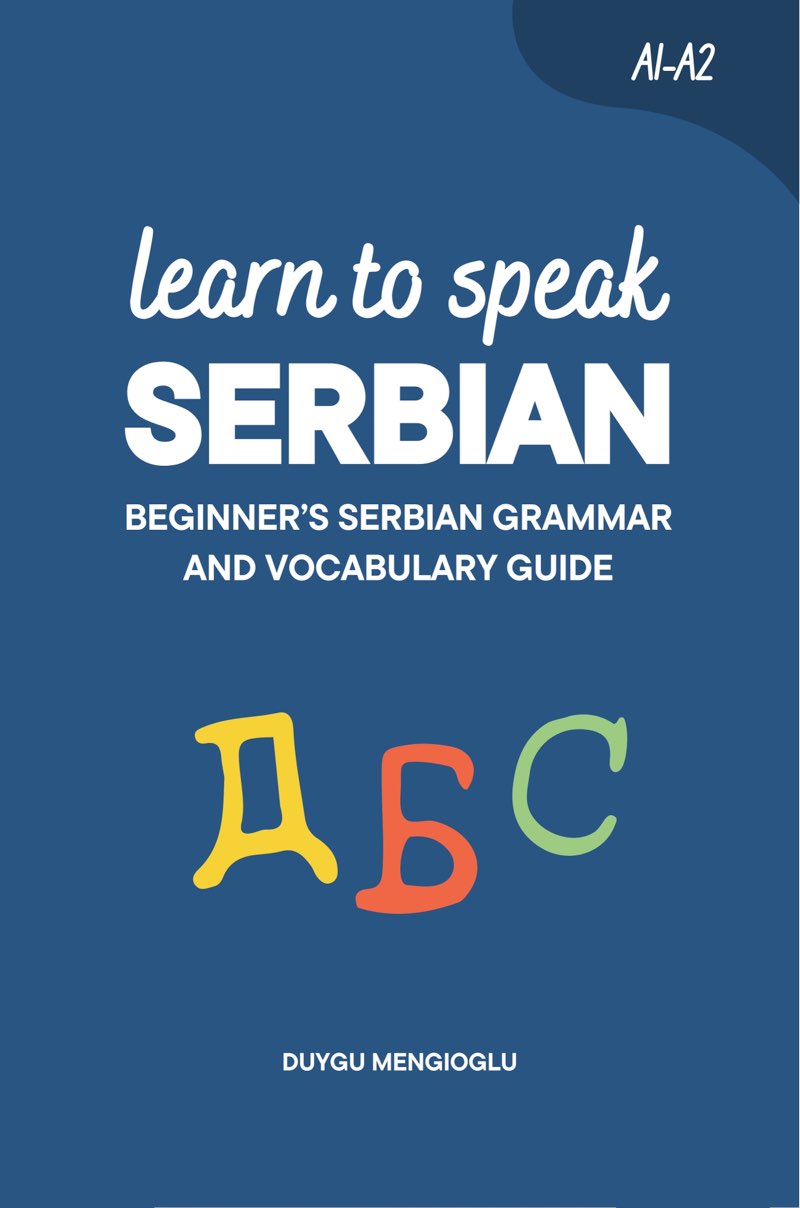
Serbian belongs to the South Slavic group and is closely related to the Bosnian, Croatian and Montenegrin standards. It is used in Serbia, in Bosnia and Herzegovina and in diaspora communities. These names have social and historical significance, while the languages share much of their structure. Indiana University's combined teaching programme introduces the named standards together and also welcomes students who have spoken the language at home.
A standard with two scripts
The modern written standard owes much to nineteenth-century reform. In their scholarly overview, Duško Vitas and colleagues describe Vuk Karadžić's work on the written language, Cyrillic alphabet and spelling. They explain that standard Serbian draws on both Ekavian and Ijekavian forms of Neo-Štokavian dialects. A named standard therefore already contains variation; it should not be mistaken for a transcript of every speaker's everyday conversation.
Serbian can be read in Cyrillic and Latin scripts. The Institute for the Serbian Language illustrates this directly by offering both script options on its website. Learning to recognise both helps readers follow material across different settings. A change of alphabet does not by itself mean that a text has changed language. The broader name Serbo-Croatian also remains important when consulting twentieth-century scholarship and older reference works.
Following words into the record
Language history survives in objects as well as summaries. Belgrade's Museum of Vuk and Dositej describes a collection containing Karadžić's first editions, archival documents and personal and family belongings. The part devoted to the educator Dositej Obradović includes correspondence and early editions of his works. These materials allow writing and educational reform to be investigated through particular publications and records, rather than treating a standard language as something created in a single moment.
The Institute for the Serbian Language maintains another substantial record through the Serbian Academy's dictionary project. Its historical title refers to the Serbo-Croatian literary and vernacular language, and its stated coverage extends across the Štokavian area. The first volume appeared in 1959. The institute describes collecting words from literary works, specialist and business writing, and regional speech. This breadth matters when a familiar word has different meanings in a novel, a trade or a local conversation.
Digital work makes additional kinds of evidence usable. The institute's digitization department lists Raskovnik, a dictionary platform, and Prepis, a project for digital editions and transcription of manuscript heritage. It also identifies a digital edition of Karadžić's Serbian folk proverbs. These projects connect contemporary technology with older written and oral records; the age of a source and its editorial treatment still matter when interpreting it.
Measuring differences carefully
Comparison with neighbouring standards requires attention to the evidence chosen. A 2016 study by Vitas and colleagues examined proposed Serbian–Croatian differences using collections of texts. Some patterns found in the SETimes news collection did not hold in other collections, and the researchers questioned how well those examples represented the standards. Their finding offers a practical caution: a contrast in one set of news reports cannot automatically stand for everything people write or say.
That approach also helps readers use dictionaries thoughtfully. A reference work's date, regional coverage and choice of texts can explain apparent disagreements. The institute's broad historical dictionary and a narrowly selected contemporary news collection answer different questions. Neither should be silently treated as a complete account of every Serbian-speaking community.
Shared movement, varied speakers
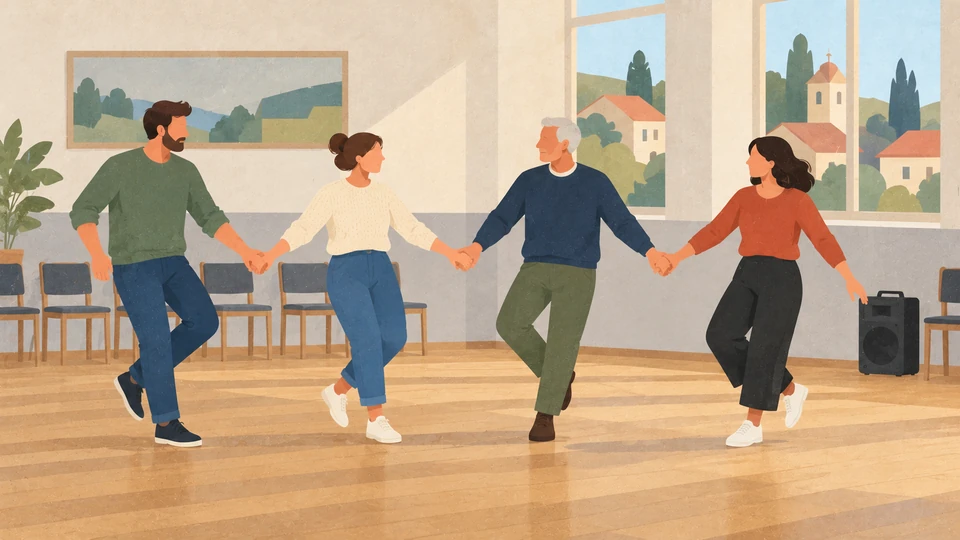
One documented cultural practice is kolo, a linked dance. The Ethnographic Museum's heritage description explains that dancers usually form an open semicircular line and move to musical accompaniment. It describes participation across generations, occupations, rural and urban settings, and ethnic and religious communities. This is a shared practice with varied participants, rather than a way to identify someone's language from their appearance.
A community rehearsal is consequently one plausible setting for conversation, listening and shared activity. The heritage account also places the dance at private and public celebrations. Alongside the manuscript, dictionary and classroom, such ordinary social settings remind readers that Serbian is used by people participating in contemporary communal life, with different interests and backgrounds.
Sources
- Indiana University Bloomington, Department of Slavic and East European Languages and Cultures. Bosnian, Croatian, Serbian. https://slavic.indiana.edu/about/languages-cultures/southslavic/index.html
- Duško Vitas, Ljubomir Popović, Cvetana Krstev, Ivan Obradović, Gordana Pavlović-Lažetić and Mladen Stanojević; in The Serbian Language in the Digital Age, edited by Georg Rehm and Hans Uszkoreit. The Serbian Language in the European Information Society (2012). https://link.springer.com/chapter/10.1007/978-3-642-30755-3_8
- Duško Vitas, Ljubomir Popović, Cvetana Krstev and Anđelka Zečević; Proceedings of the Second International Conference on Computational Linguistics in Bulgaria. How to Differentiate the Closely Related Standard Languages?. https://aclanthology.org/2016.clib-1.1.pdf
- Institute for the Serbian Language, Serbian Academy of Sciences and Arts. Одсеци. https://www.isj.sanu.ac.rs/odseci/
- Institute for the Serbian Language, Serbian Academy of Sciences and Arts. Одсек за дигитализацију. https://www.isj.sanu.ac.rs/odseci/odsek-za-digitalizaciju/
- Centre for Intangible Cultural Heritage, Ethnographic Museum in Belgrade. Kolo dance, three-steps kolo, six-steps kolo, (Коло, коло у три, коло у шест). https://nkns.rs/en/popis-nkns/kolo-dance-three-steps-kolo-six-steps-kolo-kolo-kolo-u-tri-kolo-u-shest
- National Museum of Serbia. Museum of Vuk and Dositej. https://www.narodnimuzej.rs/about-museum/locations-of-the-national-museum/museum-of-vuk-and-dositej/?lang=en