Languages & Culture
Slovenian
A language with several neighbouring settings
Slovenian, also called Slovene, is a South Slavic language related to Croatian and Serbian. Its communities include people in Slovenia and neighbouring parts of Austria, Hungary and Italy. These locations matter when considering both its public status and its regional varieties: the language's geographical reach extends across state boundaries.
Within Slovenia, Slovenian is the national official language. Italian and Hungarian also have official status alongside it in the relevant minority areas. Slovenian is an official language of the European Union as well. These arrangements describe public functions; they do not imply that every resident has the same linguistic background or that every conversation follows the written standard.
Manuscripts, print and changing evidence
The Freising Manuscripts preserve early Slovenian in Latin letters. Their scholarly digital edition identifies three religious texts: two forms of confession and a sermon inviting repentance. It dates their writing most probably to shortly before the year 1000 and locates their use in Upper Carinthia. The edition brings together transcriptions, translations and scholarly commentary. Its accompanying spoken reconstruction is a modern scholarly interpretation of historical language, a different kind of evidence from an original recording.
Printing opened another chapter. Primož Trubar's catechism and primer appeared in 1550 as the first printed Slovenian books. Their production history has remained a subject of research. In a 2013 article, Kozma Ahačič drew on Helmut Claus's comparison of printing materials and reassessed written sources to attribute their printing to Peter Frentz in Schwäbisch Hall. Even familiar milestones can become better understood when researchers return to the physical and documentary evidence.
Counting two in grammar
Slovenian grammar distinguishes singular, dual and plural. The dual provides forms associated with two people or things, and number affects nouns as well as agreeing words such as adjectives and verbs. For learners, the important point is that number can shape several parts of a phrase, rather than appearing only in a numeral.
Regional speech complicates any simple rule about universal usage. Tjaša Jakop's 2010 research describes variation in how dialects retain dual forms. Depending on the variety, distinctions can differ by grammatical gender, case or word class. The standard and local patterns therefore need to be distinguished. A learner hearing a different form in conversation should investigate the speaker's variety and context before assuming an error.
Dictionaries that connect different kinds of knowledge
The Fran Ramovš Institute of the Slovenian Language develops resources for these varied needs. Its Fran portal connects dictionaries, historical resources, dialect material and language advice. The school-oriented Franček portal brings together meanings, grammatical forms, pronunciation, word origins and other information for pupils and teachers. Such resources offer several routes into a word: its current meaning, its older record or its use in a particular variety.
The institute's December 2025 update shows this work continuing. The third part of the Slovenian Linguistic Atlas focuses on farming, including names for cultivated land, tools, tasks and mountain pasturing. Its material comes from locations within Slovenia and neighbouring regions. Maps are accompanied by commentary, while the supporting documentation identifies recording dates and contributors. This lets readers connect vocabulary with the circumstances in which it was collected, rather than assume every mapped form is equally current everywhere.
Seeds, stories and a local library
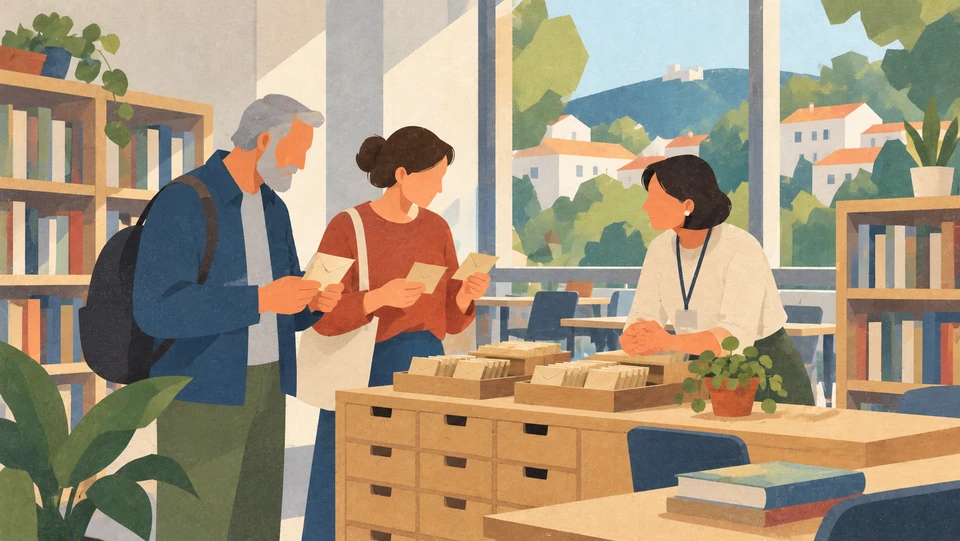
Gardening knowledge also has a contemporary community setting. The France Bevk Public Library in Nova Gorica runs a seed-library project based on free exchange. Its own description links seed sharing with practical knowledge, community relationships and the preservation of cultivated plants. The activity offers reasons to explain what was grown, compare methods and pass on experience. It is one local example of cultural participation in an ordinary public space.
A library announcement took the connection with storytelling further. The library invited contributions of gardening memories, photographs, recipes and accounts of seed saving for a collection planned for 18 November 2026. It proposed writing down participants' stories and publishing material on the Kamra heritage portal with author credit. That is a documented plan, rather than a completed archive. It illustrates how local institutions can connect practical activities with the preservation of people's words and memories.
Sources
- Center for Language Technology, Indiana University. Slovene. https://celt.indiana.edu/portal/Slovene/index.html
- Government Communication Office, Republic of Slovenia. Official language. https://www.gov.si/en/topics/official-language/
- Matija Ogrin, digital-edition editor; Tomaž Erjavec, digital encoding; Institute of Slovenian Literature and Literary Studies, ZRC SAZU. Brižinski spomeniki / Monumenta Frisingensia (Freising Manuscripts). https://nl.ijs.si/e-zrc/bs/index-en.html
- Kozma Ahačič; Fran Ramovš Institute of the Slovenian Language ZRC SAZU and University of Nova Gorica; Slavistična revija. Nova odkritja o slovenski protestantiki. https://srl.si/sql_pdf/SRL_2013_4_01.pdf
- Universal Dependencies contributors; Slovenian documentation. Number: number. https://universaldependencies.org/sl/feat/Number.html
- Tjaša Jakop; Slavia Centralis; Digital Library of the University of Maribor. Dvojinske in pluralizirane oblike v slovenskih narečjih / Dual and pluralised forms in Slovene dialects. https://dk.um.si/IzpisGradiva.php?id=69543&lang=eng
- Fran Ramovš Institute of the Slovenian Language, ZRC SAZU. About us — About the Institute. https://isjfr.zrc-sazu.si/en/predstavitev
- Fran Ramovš Institute of the Slovenian Language, ZRC SAZU. Updates to the Fran and Franček Portals (2025-12-03). https://isjfr.zrc-sazu.si/en/novice/updates-to-the-fran-and-francek-portals
- Goriška knjižnica Franceta Bevka Nova Gorica (France Bevk Public Library). O knjižnici semen. https://www.gkfb.si/za-uporabnike/knjiznica-semen/1124-o-knjiznici-semen
- Goriška knjižnica Franceta Bevka Nova Gorica (France Bevk Public Library). Sejalci zgodb – zbiranje spominov. https://www.gkfb.si/dogodki/obvestila/2506-sejalci-zgodb