Language & culture
Western Apache: A Language of Arizona
Language at a glance
- Speakers
- Fewer than 14,000 native speakers
Worldwide; 2008 reference, collection year unknown.
- Local names
- Nnee Biyáti’ · Dil’zhe’e
San Carlos language; Verde Valley Apache people.
- Communities
- Arizona
San Carlos, White Mountain, Verde Valley.
- Family
- Athabaskan
Southern branch, also called Apachean.
- Writing
- Dilzhe’e dictionary alphabet: 56 symbols
Latin-based; includes six parenthesized entries.
- Varieties
- San Carlos · White Mountain · Dilzhe’e
Consortium dictionary groupings; local spellings vary.
Who speaks Western Apache, and what do they call it?
Western Apache is spoken in San Carlos, White Mountain and Verde Valley communities in Arizona. Nnee Biyáti’ is its San Carlos name; Dil’zhe’e names the Apache people of the Yavapai-Apache Nation. The nation also includes Yavapai speakers, whose language belongs to the Yuman family.
How many people speak Western Apache worldwide?
The Endangered Languages Project records fewer than 14,000 native speakers worldwide, from a reference published in 2008. The collection year is unspecified, so this is a historical estimate.
Where did Western Apache come from, and who spoke it in the past?
Western Apache belongs to Southern Athabaskan, or Apachean. Its ancestry connects it with Athabaskan peoples of the western Subarctic; the timing and route south remain debated.
In 1875, the United States forcibly moved Yavapai and Apache people from the Camp Verde Reservation to San Carlos. An early written record is John B. White's Apache vocabulary collected at San Carlos in 1873–1875.
Which Western Apache words might an English speaker already recognise?
The White Mountain word shúgé, “sugar,” comes from English sugar. bésoh, “money,” comes from Spanish peso.
How does Western Apache vary from region to region?
The Apache Language Consortium's dictionary project distinguishes San Carlos, White Mountain and Dilzhe’e. Cibecue, on the Fort Apache Reservation, has its own documented variety; Dilzhe’e is associated with the Verde Valley. The Yavapai-Apache Nation's communities include Tunlii, Middle Verde, Rimrock, Camp Verde and Clarkdale.
What is Standard Western Apache, and where is it used?
College materials, community dictionaries and school resources use local spellings. The Dilzhe’e dictionary presents a proposed system, with some choices still unsettled. At San Carlos Apache College, Apache appears in teaching materials and a bilingual welcome poem.
Which alphabet does Western Apache use, and what might surprise an English speaker?
The Dilzhe’e dictionary's Latin-based alphabet lists 56 symbols, including six parenthesized entries. Consonant combinations and short, long and nasal vowel forms count as entries; tone marks do not add entries.
Doubled vowels mark length, a hook below marks nasal pronunciation, and an acute accent marks high pitch. The apostrophe represents a throat closure like the break in English uh-oh.
Does Western Apache have grammatical gender?
Western Apache does not divide nouns into masculine and feminine classes. The San Carlos pronoun Bīī covers both “he” and “she.”
How do you say hello and thank you in Western Apache?
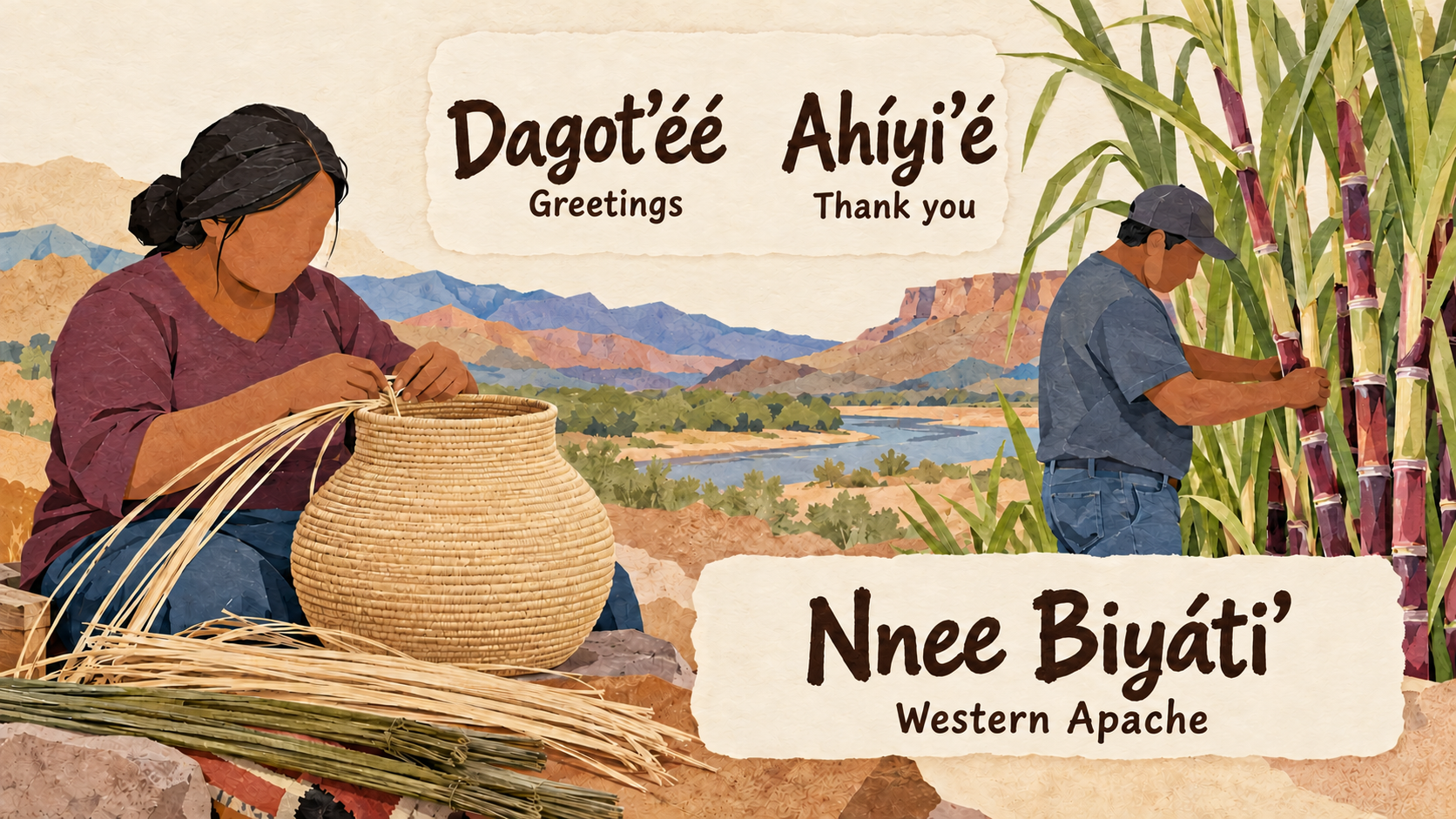
In San Carlos:
- Dagot’éé — greetings.
- Ahíyi’é — thank you.
What are some memorable Western Apache sayings?
- In White Mountain, “full of money” means wealthy. One speaker rejected using it about oneself because boasting could invite trouble.
What everyday customs might surprise a visitor?
In 1960s Cibecue, new acquaintances could take time to become familiar before speaking. Keith Basso recorded two men working alongside each other at a cattle roundup for several days before conversing. Their companions did not press them; speaking too quickly could suggest wanting something.
Which Western Apache-language song and film offer a cultural introduction?
Folkways released Western Apache: Sunrise Song in 1951. The Apache-language recording features Gin Riley on chorus and drums, with Herbert Tessay among the other drummers.
Apache 8 (2011), directed by Sande Zeig, follows women from the White Mountain Apache firefighting crew. The 57-minute documentary uses English and Apache; the Docuseek edition lists English subtitles.
What is available for someone curious about the language now?
Whiteriver Unified School District's speaking dictionary grew out of Alchesay High School students' work on the White Mountain Apache Reservation. Its phrase recordings cover destinations and weather. An online dictionary is available for Dilzhe’e.
The San Carlos Apache Vocab Builder combines recorded words and pictures. The tribal language program's 2023 description includes free classes, family outreach, work with elders and a master-and-apprentice program.
Annette Ayze's A Warm Welcome to My Apache People, in the college's 2024–2025 catalog, appears in Apache and English. It thanks students and pictures them taking what they have learned on a journey.
Fun Facts
- Grandfather is more specific than one English word suggests. The White Mountain school dictionary distinguishes shiwóyé hastiin, a mother's father, from shichoo, a father's father.
- One short entry can carry a whole English phrase. The same dictionary gives nabíí'ees for “she is having a sunrise dance.”
Sources
- Grambank Consortium; Biu H. Huntington-Rainey, contributor. Western Apache, feature GB051: sex-based noun classification. Undated database record, citing de Reuse 2006, pp. 115–117. https://grambank.clld.org/valuesets/GB051-west2615
- Grambank Consortium; Biu H. Huntington-Rainey, contributor. Western Apache, feature GB053: animacy-based noun classification. Undated database record, citing de Reuse 2006, pp. 115–117. https://grambank.clld.org/valuesets/GB053-west2615
- Willem de Reuse and Phillip Goode. A Practical Grammar of the San Carlos Apache Language. LINCOM Europa, 2006. College-linked public PDF; relevant sections on demonstratives and classificatory verbs. https://ugc.production.linktr.ee/598eb608-e517-4cdf-9081-e56b595bf93b_DeReuse-Grammar-SCApache.pdf
- Grambank Consortium. Feature GB051: definition and coding guidance. Undated. https://grambank.clld.org/parameters/GB051
- Apache Language Consortium. Projects. n.d. https://apachelanguage.org/projects/
- The Language Conservancy. SanCarlos Apache Vocab Builder. Apple App Store developer listing and version history. n.d. https://apps.apple.com/us/app/sancarlos-apache-vocab-builder/id1533992804
- Basso, Keith H. “To Give up on Words”: Silence in Western Apache Culture. Southwestern Journal of Anthropology 26(3), 1970, pp. 213–230. https://web.stanford.edu/~eckert/Courses/l1562018/Readings/Basso1970.pdf
- Basso, Keith H. Western Apache Language and Culture: Essays in Linguistic Anthropology. University of Arizona Press, 1990. Publisher description and contents. https://www.bibliovault.org/BV.book.epl?ISBN=9780816513239
- de Reuse, Willem. Denominal Verbs in Apachean Languages. International Journal of American Linguistics 74(4), 2008, pp. 423–438. Author-uploaded text. https://www.researchgate.net/publication/249112006_Denominal_Verbs_in_Apachean_Languages
- Docuseek. Apache 8. Film metadata and caption transcript. n.d. https://docuseek2.com/wm-apache
- Endangered Languages Project. Western Apache: North America source record, citing Golla, Goddard, Campbell, Mithun, and Mixco, 2008. https://www.endangeredlanguages.com/fil/node/92229
- Perry, Richard J. Western Apache Heritage: People of the Mountain Corridor. University of Texas Press, 1991. Publisher description. https://utpress.utexas.edu/9780292765252/
- Pilling, James C. Catalogue of Linguistic Manuscripts in the Library of the Bureau of Ethnology, p. 577. Smithsonian Institution, Bureau of Ethnology. n.d. https://repository.si.edu/bitstream/handle/10088/91609/Catalogue%20of%20Linguistic%20Manuscripts.pdf
- San Carlos Apache College. Apache Language Resources. n.d. https://www.apachecollege.org/apache/
- San Carlos Apache College. Catalog 2024–2025, version 1.3, p. 149, Annette Ayze, A Warm Welcome to My Apache People. https://www.apachecollege.org/wp-content/uploads/2025/08/SCAC-2024-2025-Catalog-v.1.3.pdf
- San Carlos Apache College. Apache Language and Culture I, APA 101-1, Summer 2025 syllabus, Monica Loas. https://www.apachecollege.org/wp-content/uploads/2025/06/APA-101-1-Summer-Syllabus.pdf
- San Carlos Apache Tribe / Chairman Terry Rambler. San Carlos Apache Language Preservation Program. June 30, 2023. https://www.chairmanterryrambler.org/san-carlos-apache-language-preservation-program/
- Smithsonian Folkways Recordings. Western Apache: Sunrise Song. Released 1951. https://folkways.si.edu/western-apache-sunrise-song/american-indian/music/track/smithsonian
- Whiteriver Unified School District. English to Apache Speaking Dictionary. n.d. https://www.wusd.us/page/apache.dictionary
- Whiteriver Unified School District. Speaking Apache Phrases. n.d. https://www.wusd.us/page/apache.phrases
- Women Make Movies. Apache 8. Film by Sande Zeig, 2011. https://www.wmm.com/catalog/film/apache-8/
- Yavapai-Apache Nation. The Pronunciation and Spelling of the Dilzhe'e Apache. n.d. https://dilzhee.western-apache.org/Spelling
- Yavapai-Apache Nation. Yavapai-Apache Nation. n.d. https://yavapai-apache.org/yavapai-apache-nation/
- Yavapai-Apache Nation. Land Exchange, “What is the cultural significance of these lands?” n.d. https://yavapai-apache.org/land-exchange/
Start learning today
Explore these books to keep learning.