
THE MINORITY DRAFT
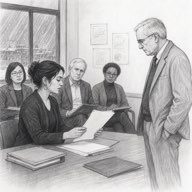
By the time the sleet reached Harvard Square, Lena Ortiz had read the disputed paragraph eleven times. Each reading made it less defensible and more familiar. Familiarity, she knew, was how dubious claims acquired furniture. They settled into a field, accumulated citations, and eventually looked too established to evict.
Professor Martin Vale stood at the conference-room window, polishing his glasses with the corner of his tie. "You are treating an omission as though it were fabrication," he said. His tone was gentle, which made the rebuke more efficient. Around the table, five members of the university's research-integrity committee examined their folders.
"An omission can become a fabrication when readers are invited to infer the opposite," Lena replied. She was the committee's youngest member and its only biostatistician. The published study claimed that a housing intervention had reduced asthma-related hospital visits across Boston. It did not mention the families excluded after enrollment.
Dean Armand Pierce tapped his pencil twice. "The question before us is narrow. Did the authors violate the protocol in force at the time?" He emphasized narrow as if breadth were an ethical lapse. Beside him, sociologist Evelyn Cho wrote something in the margin, then covered it with her hand.
The study had made Vale famous beyond the modest borders of public-health scholarship. City councils cited it. Foundations reproduced its clean bar charts. A senator had quoted its conclusion during a hearing, omitting the qualifying clause that Vale himself now described as indispensable. Reporters reduced its cautious title to a confident slogan. The paper had become influential partly by being easier to repeat than to read.
Lena opened the supplementary file. "Forty-three families disappeared from the analysis because they moved before the final interview. Thirty-eight lived in buildings awaiting eviction or conversion. Their hospital records remained available, but the team stopped requesting them." She looked at Vale. "Who made that decision?"
"My project manager, according to the audit trail." Vale replaced his glasses. "She believed continued contact could expose undocumented tenants. It was a defensible privacy judgment." Evelyn finally spoke. "Defensible to whom? The families, the institution, or the result? Those are not necessarily the same constituency."
Vale's attorney, Miriam Beck, had been permitted to observe but not participate. She raised one finger. Pierce sighed. "A factual clarification only." Miriam nodded toward the file. "The project manager died three years ago. Professor Vale cannot interrogate her reasoning, and the committee should resist converting silence into culpability."
The dead manager was Priya Nair, whose name appeared sixth in the author list. Lena had found her archived emails that morning. One message to Vale said, "Removing the displaced group will make the intervention look portable when it is not." Vale had replied, "We can litigate the denominator after the policy window closes."
Lena slid copies across the table. Vale read the exchange without visible surprise. "That sentence is graceless," he said. "It is not an instruction to falsify anything." "No," Lena agreed. "It is an instruction to postpone precision until precision becomes inconvenient. That distinction may matter procedurally. It does not help the reader."
During the break, Evelyn found Lena beside a vending machine that accepted neither cash nor apology. "You have already decided," she said. Lena selected coffee and received broth. "So has everyone else." Evelyn tasted the cup and winced. "Deciding early is not the same as deciding honestly. What outcome are you protecting?"
Lena wanted the paper retracted. Yet the intervention itself had improved ventilation in hundreds of apartments. A retraction could give landlords an excuse to abandon similar programs. Leaving the paper untouched would preserve a useful policy through a misleading premise. The choice felt less like truth versus expediency than one kind of public harm bidding against another. Moral clarity, she suspected, was sometimes retrospective privilege masquerading as courage.
When the committee reconvened, Pierce proposed a correction. The missing records could be analyzed, the limitations expanded, and Priya's concern acknowledged. "Retraction is a blunt instrument," he said. "We should not burn down a valid finding because its scaffolding was untidy." The metaphor passed uncontested, though Lena thought scaffolding was precisely what kept buildings from collapsing.
Vale surprised them by objecting. "A correction implies that the original article survives the new analysis." He turned to Lena. "It will not, will it?" She explained that including the displaced families erased the headline effect. The intervention helped stable tenants, but the benefit vanished among those facing housing insecurity. The paper's universal claim was untenable.
Miriam whispered, "Martin, you need not volunteer a conclusion." Vale smiled without amusement. "For twenty years, counsel has warned me against sentences that can be quoted. The successful ones were merely quoted without warning." He asked Lena whether the revised analysis was sound. "Within the limits of the records, yes," she said.
Pierce called for a vote on retraction. Evelyn voted yes. One other member voted no, and another abstained because his center had received money from the same foundation. Pierce voted no, leaving Lena to create a tie. Under committee rules, a tie meant no recommendation and an administrative review that could last a year.
Before Lena spoke, Vale placed a stapled document before her. It was a draft retraction notice bearing his signature. Priya's contribution was named first. The notice did not blame her; it quoted her warning and acknowledged that Vale had overruled it. "I prepared that last night," he said. "I was curious whether anyone would require it."
Pierce's pencil stopped. "This is becoming theatrical." "It became theatrical when the university hired counsel to observe a conversation about candor," Vale replied. Miriam closed her portfolio, neither offended nor surprised. Lena understood then that Vale had not come to defend the paper. He had come to discover whether the institution would let him surrender it.
Lena voted for retraction. The motion then passed three to one, with one abstention, after Pierce changed his vote for the record. His revised minutes described a vigorous consensus. Evelyn read the phrase aloud and laughed once. "Consensus," she said, "is disagreement after the upholstery has been replaced."
Outside, the sleet had become rain. Vale asked Lena whether she thought the retraction would repair anything. "No," she said. "It will make the damage legible." He nodded, as though this were both less and more than he had hoped. By morning, Priya's buried objection would be the paper's most durable result.
VOCABULARY
dubious: not fully convincing, reliable, or morally sound
defensible: capable of being justified with credible reasons
omission: something relevant that has been left out
fabrication: the deliberate invention or falsification of information
infer: to reach a conclusion from evidence rather than an explicit statement
integrity committee: a body that investigates whether professional research standards were followed
constituency: a group whose interests a person or institution represents
audit trail: a chronological record showing who changed or handled information
culpability: responsibility for wrongdoing or fault
qualifying clause: language that limits the force or scope of a claim
policy window: a limited period when political or institutional change is feasible
litigate: to contest a matter formally, especially through legal or procedural argument
denominator: the total population or baseline against which a rate is calculated
procedurally: with respect to established rules or formal processes
expediency: the pursuit of an immediate practical advantage despite possible principle-based costs
scaffolding: a temporary supporting structure; figuratively, the support underlying an argument
untenable: impossible to defend or maintain convincingly
retraction: a formal withdrawal of a published statement or article
contrition: sincere remorse for wrongdoing
abstain: to decline to cast a vote
recuse oneself: to withdraw from a decision because of a conflict of interest
vigorous consensus: supposedly strong agreement, often phrased to conceal earlier disagreement
retrospective: formed by looking back at events after their outcome is known
make damage legible: to render harm visible and understandable even when it cannot be undone
acquire legitimacy: to come to be treated as valid or authoritative over time
settle into a field: to become embedded in a discipline's accepted assumptions
portable finding: a conclusion assumed to apply reliably across different settings
overrule: to reject another person's objection by exercising greater authority
headline effect: a simplified main result designed to attract attention or travel easily
universal claim: an assertion presented as true across all relevant groups or circumstances
conflict of interest: a competing personal or institutional interest that may distort judgment
candor: direct and honest expression, especially when disclosure carries risk
institutional incentive: a reward or pressure built into an organization's practices
durable result: an outcome or insight that continues to matter over time
MULTIPLE-CHOICE QUESTIONS
1. What does the opening metaphor about dubious claims acquiring furniture imply?
A. False claims literally require institutional offices
B. Repeated claims can become normalized and difficult to challenge
C. Academic studies should avoid figurative language
D. Citations always prove that a claim is correct
2. Why does Pierce repeatedly define the committee's question as narrow?
A. He wants to focus exclusively on Boston housing law
B. He lacks access to the missing hospital records
C. He prefers procedural compliance to a broader ethical judgment
D. He believes Lena has misunderstood the study design
3. What is Priya's central warning about removing displaced families?
A. The intervention will appear more broadly applicable than the evidence permits
B. The foundation will withdraw its funding immediately
C. Tenant identities will be revealed in the article
D. The hospital records will become statistically unusable
4. What does Vale's phrase about litigating the denominator after the policy window closes reveal?
A. He intended to sue the city after publication
B. He prioritized timely influence over resolving a known analytical objection
C. He believed Priya had calculated the denominator incorrectly
D. He expected the committee to reject all policy research
5. Why is Lena initially troubled by retraction despite wanting it?
A. She fears losing her committee appointment
B. She doubts whether the archived emails are authentic
C. Landlords may exploit the retraction to abandon beneficial programs
D. Priya's family has requested that the paper remain published
6. Why does Lena object internally to Pierce's scaffolding metaphor?
A. Scaffolding is unrelated to urban housing
B. It minimizes structural support as mere untidiness
C. It implies the intervention was too expensive
D. It gives Vale sole credit for the research
7. What does Vale's pre-signed retraction draft most strongly suggest?
A. He expected Lena to write the notice for him
B. He came partly to test whether the institution would demand accountability
C. He planned to blame Priya for the missing data
D. He misunderstood the committee's authority
8. Why does Miriam warn Vale against volunteering a conclusion?
A. His acknowledgment could damage his legal and professional position
B. She believes the revised analysis is statistically invalid
C. She wants the committee to interview Priya
D. She thinks the hearing has become too informal
9. What is ironic about the phrase 'vigorous consensus' in the revised minutes?
A. The decision concerns exercise rather than research
B. The phrase records disagreement more precisely than the vote
C. It repackages a contested process as seamless agreement
D. It was originally coined by Evelyn
10. Why does Lena say retraction will make the damage legible rather than repair it?
A. The withdrawal can reveal the wrong without reversing its policy consequences
B. The committee lacks permission to publish a correction
C. The families can no longer be identified
D. The original journal will refuse to acknowledge the decision
FILL IN THE BLANKS
Complete each item, then briefly explain the collocational, semantic, or register constraint that makes your answer preferable to the nearest plausible alternative.
1. The internal _____ showed that three analysts had altered the file before publication.
2. Because the judge owned shares in the supplier, she chose to _____ from the case.
3. The spokesperson added a _____ limiting the promise to customers enrolled before June.
4. The committee rejected the universal claim as _____ once the regional exceptions were examined.
5. The editor issued a full _____ after learning that the central source had been invented.
6. Short-term _____ encouraged the board to conceal costs that would emerge the following year.
7. From the pattern of deleted messages, investigators could reasonably _____ an attempt to obstruct review.
8. The representative had ignored an important _____: residents who relied on public transit.
9. The witness chose to _____ because she could not support either proposal in its current form.
10. The apology expressed genuine _____ without demanding immediate forgiveness.
COMPREHENSION QUESTIONS
1. How does the story distinguish a privacy judgment from an ethically neutral decision?
__________________________________________
2. Why is Lena's early desire for retraction not presented as simple moral certainty?
__________________________________________
3. What does Evelyn mean when she asks Lena which outcome she is protecting?
__________________________________________
4. How does the story portray the relationship between influence and simplification?
__________________________________________
5. Why is Priya's position in the author list ethically important?
__________________________________________
6. What competing functions could a correction and a retraction serve in this case?
__________________________________________
7. How does Vale's behavior complicate the role of the accused researcher?
__________________________________________
8. What institutional weakness is revealed by the committee's concern with quotable sentences?
__________________________________________
9. Interpret Evelyn's upholstery metaphor about consensus.
__________________________________________
10. Why might Priya's objection become the paper's most durable result?
__________________________________________
TRUE/FALSE QUESTIONS
Mark each claim True or False. Base your judgment on implication, rhetorical force, and qualified evidence rather than isolated keyword matching.
1. The exclusion decision can protect tenants and still embody a contestable institutional value judgment.
2. Because the ventilation program produced public benefits, the study's universal causal claim remains methodologically sound.
3. The story treats retraction as a sanction reserved for deliberate fabrication.
4. Priya's low position in the author list prevents her objection from carrying evidentiary weight after her death.
5. Vale's prepared retraction complicates, but does not cancel, his responsibility for defending the original analysis.
6. The committee's concern with quotable wording shows that reputational risk shapes what participants are willing to say.
7. A revised analysis may preserve practical support for ventilation while defeating the paper's headline generalization.
8. Evelyn's upholstery metaphor presents a polished consensus statement as proof that disagreement has been resolved.
9. Including Priya's warning in the retraction notice changes her private dissent into part of the durable scholarly record.
10. The ending assumes that scientific accuracy and immediate public benefit will always recommend the same remedy.