
THE FLOODPLAIN ARGUMENT
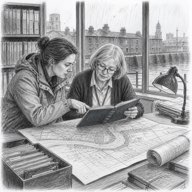
By the time Mara Velez found the blue survey notebook, North Sea rain had already made a bad metaphor of Hull. Water feathered across the office windows, the road gullies gargled, and every television weather presenter stood beside a red warning map as if uncertainty were something a person could cordon off.
The notebook lay inside a mislabelled archive box at the council's Flood and Drainage Archive, beneath invoices for concrete and a retirement card signed in 1987. Its pages contained elevation readings from the Humber wetlands, recorded before the navigation channel had been widened. One sentence in the margin stopped her: Protection follows value, unless value is assigned after protection.
“That sounds less like engineering than a confession,” said Theo Bell, the council archivist. He had the enviable habit of reading upside down. “Whose handwriting?”
“Elias Wren. Senior hydrologist, 1964 through 1989.” Mara photographed the page. “He also drew an alternative flood-bank alignment. It would have put Marsh End inside the protected basin.”
Theo glanced toward the locked door. “And the alignment they built left it out.”
Marsh End was not an officially defined neighbourhood. It was what residents called a dozen streets of raised cottages, garages, chapels, and narrow Victorian terraces that maps alternately labelled industrial buffer, underutilised land, or nothing at all. After the last North Sea surge, insurers had learned its boundaries with predatory precision. The council’s redevelopment plan now described it as “adaptable land.”
Mara worked for Delta Meridian, the engineering firm hired to certify that redevelopment plan. Her assignment sounded bloodless: update the flood model, test the proposed drainage pumps, and state whether six hundred flats could be built without increasing risk elsewhere. The model said yes, but only because its historical baseline began in 1992—three years after Wren retired and twenty-eight years after his rejected alignment disappeared.
At Monday’s project meeting, Director Russell Dane advanced through slides with the frictionless confidence of a man who had never been asked to evacuate. “The residual risk is statistically negligible,” he said. “Let’s not burden decision-makers with archaeological hydrology.”
Mara placed the notebook on the table. “The old wetlands absorbed surge differently before subsidence and channel expansion. If Wren’s measurements are sound, our baseline understates the burden already transferred to Marsh End.”
Russell did not touch the notebook. “If they are sound. Handwritten readings without calibration records are anecdotes wearing decimals.”
“Then we test them.”
“We are not retained to litigate the twentieth century.” His smile was almost paternal, which made it worse. “We are retained to model a project in the present.”
That evening Mara visited Marsh End with Imani Brooks, who ran a small accountancy office from the front room of her grandmother’s house. Imani had opposed the redevelopment, though she distrusted environmental arguments that treated residents as picturesque victims. “People discover our vulnerability whenever they want our land,” she said. “When we ask for pumps, suddenly the science is inconclusive.”
They walked to a vacant plot where concrete steps rose toward a house that no longer existed. Imani showed her nail heads driven into a telegraph pole at the height of each flood. The highest carried a strip of yellow ribbon. “My grandmother measured water with her body,” she said. “Hip, waist, ribs. Does your notebook speak that language?”
“Not directly.” Mara opened to a sketched cross-section. “But it explains why the water came here.” She described the rejected flood bank, the altered basin, and the modern model’s truncated history. Technical terms felt indecent in the damp air, yet euphemism would have been worse. “I can prove the present analysis is incomplete. I can’t prove the old alignment would have saved every house.”
Imani studied her. “Good. Certainty is usually the first thing outsiders sell us. What can you prove by Thursday?”
Mara borrowed a portable level, recruited two postgraduate students, and spent the next forty hours reconciling Wren’s benchmarks with current survey monuments. Several had sunk; one had been paved over; another survived behind a launderette beneath three layers of paint. The notebook’s numbers were not perfect, but their errors were systematic, legible, and correctable. That made them evidence.
The harder problem was causation. A city is not a bath, despite the diagrams used to explain it. Water obeys elevation, friction, soil, wind, maintenance schedules, political boundaries, and the small decisions by which one district’s safety becomes another’s exposure. Mara rebuilt the model with three historical baselines and ran each scenario until her laptop sounded asthmatic.
The result was not the catastrophe she had half expected. The new development would not dramatically flood Marsh End by itself. It would, however, consume most of the drainage margin that planners claimed was available for future protection. The project was safe only if one treated the neighbourhood’s existing danger as a permanent condition rather than an obligation to be reduced.
Russell read her memorandum in silence. “You’ve changed the question,” he said at last.
“The original question was designed to produce yes.”
“Every engineering question has boundaries.”
“Boundaries are not neutral when the water crosses them.” Mara heard Wren’s sentence beneath her own. “We can certify the buildings if the council funds the eastern pumping station first and reserves drainage capacity for Marsh End. Otherwise our conclusion is technically defensible and substantively false.”
At the planning committee hearing, Russell presented the conditional finding without mentioning their argument. Developers objected to the pumping station; councillors objected to delay; residents objected to being discussed in the future tense. Then Imani held up a copy of the blue notebook. “This council has been calling our risk temporary for sixty years,” she said. “Temporary is a word powerful people use when they expect someone else to outlive the consequence.”
The council postponed the vote and ordered an independent review. It was not victory. Postponement could be a waiting room where decisions went to lose witnesses. Yet the next morning, the redevelopment map labelled Marsh End by name, and the finance directorate requested a cost estimate for the pumping station. Mara returned the notebook to its box, corrected the label, and added a note of her own: Uncertainty is not ignorance. It is a debt that must be assigned.
VOCABULARY
road gullies: street-level drains that carry rainwater away from the carriageway
cordon off: to close or isolate an area with a protective boundary
mislabelled: marked with an incorrect or misleading description
alternative flood-bank alignment: a different proposed route for a flood-protection embankment
industrial buffer: land used to separate industrial activity from other districts
underutilised land: property officially judged to be used below its supposed capacity
adaptable land: a euphemistic planning term for land available for redevelopment
predatory precision: exactness used exploitatively against vulnerable people
bloodless: deliberately detached from the human consequences of a decision
residual risk: danger that remains after protective measures have been applied
statistically negligible: so small in numerical terms that it is treated as insignificant
archaeological hydrology: a dismissive phrase for investigating old water-management evidence
calibration records: documents showing how measuring instruments were checked for accuracy
anecdotes wearing decimals: a metaphor for weak evidence disguised by numerical form
truncated history: a historical record cut off so that relevant earlier evidence disappears
systematic: following a consistent pattern rather than occurring randomly
legible: clear enough to be read or interpreted
drainage margin: unused capacity left in a system for carrying away water
technically defensible: supportable under a narrow professional standard
substantively false: misleading in its real-world meaning despite formal plausibility
MULTIPLE-CHOICE QUESTIONS
- Which C2-level reading best captures the idiomatic and figurative force of “made a bad metaphor of Hull”?
- It is a strictly literal technical description whose meaning is exhausted by the physical scene.
- It functions only as incidental humour and has no bearing on the story’s institutional conflict.
- It converts a concrete situation into a figurative judgment about how technical boundaries distribute environmental risk and civic obligation, so the reader must interpret rather than merely decode it.
- It supplies a final verdict that makes every later qualification unnecessary.
- Which C2-level reading best captures the idiomatic and figurative force of “anecdotes wearing decimals”?
- It converts a concrete situation into a figurative judgment about how technical boundaries distribute environmental risk and civic obligation, so the reader must interpret rather than merely decode it.
- It functions only as incidental humour and has no bearing on the story’s institutional conflict.
- It supplies a final verdict that makes every later qualification unnecessary.
- It is a strictly literal technical description whose meaning is exhausted by the physical scene.
- Which C2-level reading best captures the implicit meaning of “Postponement could be a waiting room where decisions went to lose witnesses.”?
- It proves that the named speaker is wholly reliable and the opposing position wholly fraudulent.
- It states the story’s judgment completely and leaves no significant inference to the reader.
- It contributes only chronological information and does not alter the ethical stakes.
- It withholds a complete verdict and requires the reader to infer the consequences of how technical boundaries distribute environmental risk and civic obligation.
- Which C2-level reading best captures the implicit meaning of “The project was safe only if one treated the neighbourhood’s existing danger as a permanent condition rather than an obligation to be reduced.”?
- It states the story’s judgment completely and leaves no significant inference to the reader.
- It withholds a complete verdict and requires the reader to infer the consequences of how technical boundaries distribute environmental risk and civic obligation.
- It contributes only chronological information and does not alter the ethical stakes.
- It proves that the named speaker is wholly reliable and the opposing position wholly fraudulent.
- Which C2-level reading best captures the register control of “The residual risk is statistically negligible”?
- It abandons professional language for casual banter and thereby suspends the conflict.
- Its technical vocabulary guarantees that the claim is objective and needs no supporting evidence.
- It is an accidental mismatch of styles that weakens the speaker’s command of English.
- It deploys a specialised or institutional register strategically inside a contested situation, making the register itself part of the power struggle.
- Which C2-level reading best captures the register control of “We are not retained to litigate the twentieth century.”?
- It deploys a specialised or institutional register strategically inside a contested situation, making the register itself part of the power struggle.
- Its technical vocabulary guarantees that the claim is objective and needs no supporting evidence.
- It is an accidental mismatch of styles that weakens the speaker’s command of English.
- It abandons professional language for casual banter and thereby suspends the conflict.
- Which C2-level reading best captures the rhetorical control of “Boundaries are not neutral when the water crosses them.”?
- It is decorative phrasing that can be removed without changing the story’s argument.
- It compresses the story’s ethical argument about how technical boundaries distribute environmental risk and civic obligation into a memorable formulation without eliminating the underlying ambiguity.
- It should be read as a literal procedural instruction rather than an evaluative claim.
- It resolves every competing interpretation by reducing the dispute to a single innocent motive.
- Which C2-level reading best captures the rhetorical control of “Temporary is a word powerful people use when they expect someone else to outlive the consequence.”?
- It should be read as a literal procedural instruction rather than an evaluative claim.
- It resolves every competing interpretation by reducing the dispute to a single innocent motive.
- It compresses the story’s ethical argument about how technical boundaries distribute environmental risk and civic obligation into a memorable formulation without eliminating the underlying ambiguity.
- It is decorative phrasing that can be removed without changing the story’s argument.
- Which C2-level reading best captures the lexical precision of “its historical baseline began in 1992”?
- It uses exact domain language to identify a mechanism relevant to how technical boundaries distribute environmental risk and civic obligation, rather than relying on a vague moral label.
- Its specialist term is sufficient by itself to prove that the institution’s conclusion is valid.
- It deliberately avoids naming any mechanism and replaces analysis with a broad euphemism.
- It uses impressionistic imagery whose value lies chiefly in atmosphere rather than accuracy.
- Which C2-level reading best captures the lexical precision of “consume most of the drainage margin”?
- It deliberately avoids naming any mechanism and replaces analysis with a broad euphemism.
- It uses impressionistic imagery whose value lies chiefly in atmosphere rather than accuracy.
- Its specialist term is sufficient by itself to prove that the institution’s conclusion is valid.
- It uses exact domain language to identify a mechanism relevant to how technical boundaries distribute environmental risk and civic obligation, rather than relying on a vague moral label.
FILL IN THE BLANKS
- The notebook lay inside a __________ archive box at the council's Flood and Drainage Archive, beneath invoices for concrete and a retirement card signed in 1987.
- “That sounds less like __________ than a confession,” said Theo Bell, the council archivist.
- “Senior hydrologist, 1964 through 1989.” Mara __________ the page.
- Theo __________ toward the locked door.
- Marsh End was not an officially defined __________.
- Mara worked for Delta Meridian, the engineering firm hired to certify that __________ plan.
- At Monday’s project meeting, Director Russell Dane advanced through slides with the __________ confidence of a man who had never been asked to evacuate.
- Mara placed the __________ on the table.
- Russell did not touch the __________.
- That evening Mara visited Marsh End with Imani Brooks, who ran a small __________ office from the front room of her grandmother’s house.
COMPREHENSION QUESTIONS
- How does “They walked to a vacant plot where concrete steps rose toward a house that no longer existed.” complicate a simple account of how technical boundaries distribute environmental risk and civic obligation?
__________________________________________
- What does the detail “‘Not directly.’ Mara opened to a sketched cross-section.” reveal about the distribution of knowledge or responsibility?
__________________________________________
- Why is “Certainty is usually the first thing outsiders sell us.” more than a factual detail in the story’s argument?
__________________________________________
- How should a careful reader connect “Mara borrowed a portable level, recruited two postgraduate students, and spent the next forty hours reconciling Wren’s benchmarks with current survey monuments.” to the story’s treatment of authority and evidence?
__________________________________________
- What qualification does “A city is not a bath, despite the diagrams used to explain it.” add to the conflict developed in this story?
__________________________________________
- How does “The result was not the catastrophe she had half expected.” complicate a simple account of how technical boundaries distribute environmental risk and civic obligation?
__________________________________________
- What does the detail “Russell read her memorandum in silence.” reveal about the distribution of knowledge or responsibility?
__________________________________________
- Why is “The original question was designed to produce yes.” more than a factual detail in the story’s argument?
__________________________________________
- How should a careful reader connect “Every engineering question has boundaries.” to the story’s treatment of authority and evidence?
__________________________________________
- What qualification does “At the planning committee hearing, Russell presented the conditional finding without mentioning their argument.” add to the conflict developed in this story?
__________________________________________
TRUE/FALSE QUESTIONS
- The council postponed the vote and ordered an independent review.
- Its pages contained elevation readings from the Humber wetlands, recorded before the navigation channel had been widened.
- The weather presenters treated their red warning maps as if they could fully contain uncertainty.
- Residents regarded the dozen streets of Marsh End as genuinely empty land.
- He had the enviable habit of reading upside down.
- “He also drew an alternative flood-bank alignment.”
- Mara's assignment required her to assess the drainage pumps without considering risk elsewhere.
- “And the alignment they built left it out.”
- The consultants were retained to model the project only as it had existed in the past.
- Every former drainage channel had either sunk or been paved over; none remained visible.