
THE SPARE KEY
Rain glazed the brick sidewalks of Chicago's Andersonville neighborhood when Mara Ellis found a brass key taped beneath her late aunt's kitchen drawer. The label read, in Evelyn's decisive handwriting, "Use this key with Mr. Bell if he finally asks you to."
Mara had never heard of Mr. Bell. She had spent three weekends sorting teacups, tax folders, and enough crossword books to supply a retirement home. Evelyn had cataloged everything except the people in her life.
"Try apartment 3B," suggested Luis, the building superintendent. He balanced a toolbox against his hip. "Calvin Bell has lived there since before the Cubs broke the curse. Your aunt and he argued like senators."
Calvin opened his door only as far as the chain allowed. He was tall, silver-haired, and impeccably dressed in a cardigan. When Mara showed him the key, his expression tightened. "She kept it, then. That was unnecessarily theatrical."
"What does it open?" Mara asked. "Something she had no right to keep," he replied. After a pause, he removed the chain. "If you are willing, I am asking you to use it with me. Come inside. The hallway has learned enough."
His apartment smelled of Earl Grey and furniture polish. On the mantel stood a photograph of Evelyn and Calvin at Wrigley Field, both wearing ridiculous foam fingers. Mara stared. "You were friends? She never mentioned you."
"We were litigants," Calvin said. "Friendship arrived later and behaved badly." He explained that they had jointly rented a safe-deposit box in 1997, after organizing tenants against a predatory landlord. Evelyn had retained its only customer key.
Evelyn had withdrawn from their friendship two years earlier. She accused Calvin of altering the building's original tenant ledger, a document that proved several elderly residents possessed protected leases. Calvin denied touching it. Neither had forgiven the other.
"The bank closes at four," Mara said, checking her phone. "If this concerns people's homes, we should stop discussing it over tea." Calvin raised one eyebrow, then reached for a charcoal overcoat.
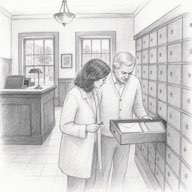
At Lakeshore Community Bank, Mara presented her executor papers while Calvin produced the original rental card from a leather coin purse. Denise verified both identities, inserted the bank's guard key, and let Mara use Evelyn's. The lock turned with a sober, mechanical click.
Inside lay the tenant ledger, a stack of notarized affidavits, and a red envelope addressed to Calvin. He exhaled sharply. "That ledger disappeared from my desk. She took it." Mara opened her mouth, but he lifted a hand.
The envelope contained a letter and a cashier's check. Evelyn admitted removing the ledger after discovering that Calvin's nephew, a property developer, had photographed it. She feared he would destroy the evidence, yet she lacked proof and distrusted Calvin's loyalty.
"She could have told me," Calvin murmured. "Would you have believed her?" Mara asked. He looked toward the closed door. "At that time, I believed family loyalty was a moral achievement. It was merely a habit."
The check covered legal fees for every protected tenant. A second note instructed Mara to deliver the documents to a housing attorney named Priya Shah. Evelyn had also written, "Calvin will know whether courage has finally become convenient."
Calvin gave a dry laugh. "She always sharpened an apology until it could draw blood." He folded the letter with painstaking precision. Then he called Priya and placed the phone on speaker.
Priya confirmed that Evelyn had consulted her anonymously. The landlord's latest buyer planned renovations and aggressive rent increases. "With the ledger and affidavits, we can seek an injunction Monday," she said. "Without them, several tenants would be vulnerable."
Mara glanced at Calvin. "Will you testify about your nephew?" He studied the cashier's check, then the old photograph from his wallet. "Yes. But I reserve the right to complain about Evelyn's methods under oath."
Outside, the rain had softened to mist. Calvin asked Mara to join him at a nearby diner, where Evelyn had once defeated him in a pie-eating contest. "She cheated," he said. "She distracted me with a fire alarm."
"Was there a fire?" Mara asked. "A very small one," he replied. "She believed rules should bend toward justice. Occasionally, they bent toward pie." On Monday, Priya filed the injunction. The tenants kept their leases while the dispute proceeded. Mara returned the brass key to Calvin, but he closed her fingers around it. "No," he said. "Evelyn left you her vote."
Only then did Mara notice the label's wording. It did not say to give Mr. Bell the key. It said to use it if he asked, and Calvin had asked at his door. Mara slipped it into her wallet beside Evelyn's grocery list. Across the table, Calvin unfolded the diner menu and began disputing the price of pie.
VOCABULARY
glaze: to cover a surface with a smooth, glasslike layer
decisive: showing firm judgment and little hesitation
catalog: to record and organize items systematically
impeccably: in a manner free from fault or untidiness
theatrical: deliberately dramatic or calculated for effect
litigant: a person involved in a lawsuit
predatory: seeking advantage through exploitation or unfair pressure
retain: to keep possession or control of something
safe-deposit box: a secured container rented inside a bank vault
executor: a person legally appointed to administer an estate
notarized: formally witnessed and certified by a notary public
affidavit: a written statement sworn to be true
cashier's check: a bank-issued check guaranteed with the bank's funds
murmur: to speak in a low, restrained voice
tenant ledger: a record of tenants, leases, and related tenancy information
under oath: while legally required to tell the truth
injunction: a court order requiring or prohibiting a specific action
vulnerable: open to harm, pressure, or exploitation
painstaking: extremely careful and attentive to detail
anonymous: not identified by name
aggressive: forceful in a way that may disregard others' interests
mist: a thin suspension of water droplets near the ground
reserve the right: to preserve one's entitlement to act or object later
bend toward justice: to interpret a rule flexibly in service of fairness
MULTIPLE-CHOICE QUESTIONS
Choose the best answer based on the story.
1. What does the wording on Evelyn's key label ultimately require?
A. Mara must mail the key to Calvin
B. Calvin must request that Mara use the key
C. Luis must witness the key exchange
D. Priya must authorize the bank visit
2. Which description best captures Evelyn and Calvin's relationship?
A. They remained hostile strangers
B. They were relatives who shared an estate
C. They moved from legal conflict into a difficult friendship
D. They were business partners who owned the bank
3. Why had Evelyn and Calvin originally rented the safe-deposit box?
A. To conceal auction proceeds
B. To preserve evidence from a tenant campaign
C. To store family jewelry
D. To finance a restaurant
4. Why can Mara enter the safe-deposit box with Calvin?
A. She has Evelyn's executor papers and customer key
B. She is a protected tenant
C. Luis has transferred the lease to her
D. Calvin names her as his attorney
5. Why did Evelyn remove the tenant ledger from Calvin's desk?
A. She wanted to revise the protected leases
B. She planned to sell it to the building's buyer
C. She feared Calvin's developer nephew might destroy it
D. She believed the affidavits were fraudulent
6. What was the cashier's check intended to fund?
A. Mara's inheritance taxes
B. Legal fees for the protected tenants
C. Repairs to the apartment building
D. Calvin's retirement expenses
7. What is Priya Shah's principal function in Evelyn's plan?
A. She authenticates the Wrigley Field photograph
B. She evaluates the building for renovation
C. She uses the recovered documents to seek legal protection
D. She mediates the friendship privately
8. What decision shows that Calvin has reconsidered family loyalty?
A. He agrees to testify about his nephew
B. He returns to Wrigley Field
C. He gives Luis the ledger
D. He refuses to read Evelyn's letter
9. What does Calvin mean when he says Evelyn sharpened an apology until it could draw blood?
A. Her apology was physically damaged
B. Her remorse was sincere but still accusatory
C. Her handwriting was impossible to read
D. Her letter threatened criminal charges
10. What does Calvin's refusal to take back the key signify?
A. The bank has invalidated it
B. He wants Mara to inherit responsibility for Evelyn's civic judgment
C. He believes Mara should sell it
D. He no longer trusts safe-deposit boxes
FILL IN THE BLANKS
Complete each sentence with the correct vocabulary word.
1. The court issued an ___________ preventing the company from demolishing the historic facade.
2. Because the witness lived abroad, she submitted a ___________ describing what she had observed.
3. The board rejected the lender's ___________ terms, which targeted owners with few alternatives.
4. As the estate's ___________, Daniel had authority to settle debts and distribute the remaining assets.
5. The laboratory kept ___________ records of every temperature change during the trial.
6. The shelter prioritizes residents who are especially ___________ to financial coercion.
7. Both parties may ___________ to challenge the ruling after the final hearing.
8. Her suit was tailored ___________, without a loose seam or uneven cuff.
9. The museum chose to ___________ the letters because they clarified the artist's intentions.
10. Each ___________ waited outside the courtroom until the clerk called the case.
COMPREHENSION QUESTIONS
Answer each question using details from the story.
1. What does Mara's sorting work suggest about Evelyn's way of managing private life?
__________________________________________
2. How does Luis's comparison to senators characterize Evelyn and Calvin?
__________________________________________
3. Why does the Wrigley Field photograph surprise Mara?
__________________________________________
4. Why does Mara insist on going to the bank instead of continuing the conversation over tea?
__________________________________________
5. What realization lies behind Calvin's comment that family loyalty was merely a habit?
__________________________________________
6. Why is placing Priya on speakerphone a meaningful action?
__________________________________________
7. Why is the planned injunction urgent?
__________________________________________
8. What does the pie-contest anecdote add to Evelyn's characterization?
__________________________________________
9. How does the weather change support the story's emotional movement?
__________________________________________
10. Why is Calvin's final complaint about pie prices an effective closing detail?
__________________________________________
TRUE/FALSE QUESTIONS
Read each statement and decide whether it is true or false.
1. Evelyn's apartment is in Chicago's Andersonville neighborhood.
2. Calvin initially opens his door without using the security chain.
3. Calvin's apartment smells of Earl Grey and furniture polish.
4. Evelyn and Calvin rented the bank box in 2007.
5. Evelyn retained the box's only customer key.
6. The red envelope inside the box is addressed to Mara.
7. The financial instrument in the envelope is a cashier's check.
8. Calvin crumples Evelyn's letter after reading it.
9. Priya says she can seek an injunction on Monday.
10. Mara stores the brass key beside Evelyn's grocery list.